For cafés & coffee shops
Social media for an independent café, in a market full of chains
There are around twenty-five thousand independent cafés and unlicensed restaurants in the UK competing with eleven thousand branded outlets that have marketing departments. What you have that they do not is a specific corner of a specific town and a person behind the counter. Both of those are content.
01 · Plan the year
The dates worth planning a counter around
A café's year is driven by weather, school terms and the small national moments people actually observe. The chains plan theirs eighteen months out with a research budget. You do not need one, you need eight dates and three weeks of notice.
-
Back to school, the first week of September
Morning trade changes shape overnight: the pushchair crowd goes quiet at nine and the pre-9am commuter trade grows.
Post Late August, and change your opening time post if your hours change with it.
-
UK Coffee Week, October
The one national coffee date with a UK charity behind it, Project Waterfall. It usually runs in mid October; confirm the current year's dates with the organisers before you print them.
Post Two weeks out, and only if you are actually doing something. A date you mention and do nothing about is worse than silence.
-
The clocks go back, Sunday 25 October 2026
The afternoon trade dies and the cosy trade starts. It is the natural switch from iced to hot, from outside tables to the window seat.
Post That weekend. It is the most reliable seasonal pivot a café has and almost nobody marks it.
-
The Christmas menu, from the second week of November
Whatever your version of the seasonal drink is, it has to arrive before the chains have finished training everybody to want theirs.
Post The first week of November. Late is the same as never on this one.
-
Small Business Saturday, 5 December 2026
A genuine UK-specific day with real public awareness, and independents are the entire point of it.
Post The Monday of that week, and say what makes you independent rather than just that you are.
-
Veganuary and Dry January
Both are real, measurable British behaviour changes for the whole of January, and both send people looking for somewhere new.
Post From the 28th of December. If you have an oat flat white and a decent alcohol-free option, January is when to say so.
-
Half terms and school holidays
They change your trade completely for a week at a time and the dates differ by council area.
Post The week before each, with whatever you do for children. Look up your own council's dates rather than a national list.
-
The first warm week, March or April
Outside tables, iced drinks, and a queue that appears with no warning. It moves by weeks between the south coast and Scotland.
Post Have it written and ready to go the moment the forecast turns. This is the one post worth having in the drawer.
How to actually do the planning
- Write down your own hours, your own half-term dates and the day your outside tables come out. That is a more useful calendar than any national one.
- For each of the dates above, decide what you are actually going to sell. A date with no offer behind it produces a post nobody acts on.
- Fill the rest with the counter. What came out of the oven, who is behind the machine, what the special is. Cafés are the one trade where daily posting is genuinely sustainable, because the material walks past you all morning.
02 · What to post
Eight things you could photograph this week
-
The bake, at seven in the morning
The tray coming out of the oven beats the finished slice under glass. Best light of the day and nobody is in the way.
-
The pour, close and slow
Latte art is a post people love to watch, and it takes four seconds to film. Do it once a week, not once a day.
-
Who is on today
Name them. People come back to a café for a person far more often than for a coffee, and the chains structurally cannot do this.
-
Where the beans are from
Name the roaster and the origin. Roasters reshare, which puts you in front of a coffee-literate audience for nothing.
-
The quiet hour
"Two till four is the good time to work here." It fills your deadest hour and it tells remote workers something they actively want to know.
-
The thing that sells out
Say what goes first and by when. It creates entirely honest urgency and it manages expectations at the same time.
-
Your table for one
Say out loud that a single person with a book is welcome for an hour. It reads as warmth and it is a real reason to choose you.
-
What you do with what is left
Too Good To Go, the food bank, the staff. Small, true, and it is the kind of thing people tell other people about.
03 · How often
How often, realistically
Five a week is achievable here in a way it is not in most trades, because the material is in front of you every morning. But the honest floor is three, and three consistently beats five for a fortnight.
Shoot in the morning, post through the day. The light is good before ten and terrible after four, and the trade you want to influence is looking at their phone at eleven and at two.
Have one post permanently in the drawer for the first warm day. It arrives without warning and you will be too busy to write it when it does.
04 · Take a better photograph
How to photograph coffee and cake on a phone
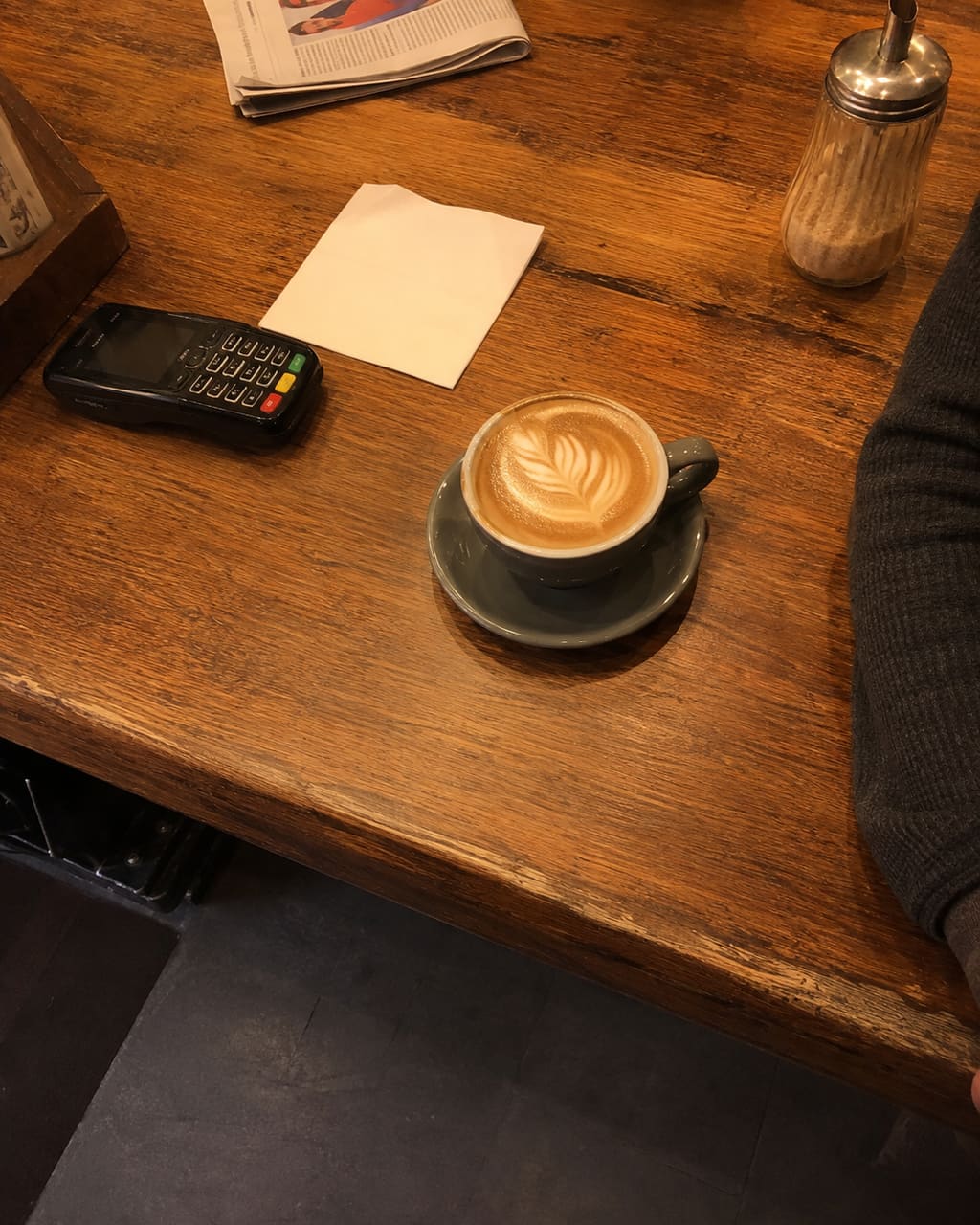
Cafés have the best light of any business on this list and mostly waste it, because the counter is under downlights and the window is where the customers are. Both frames below are the same flat white, three minutes apart, no editing.

Illustrative examples, generated rather than photographed in a real business.
-
Use the window table, always
Warm downlights turn milk yellow and make crema look muddy. Daylight from the side keeps white things white. Keep one table near the window clear for thirty seconds at a quiet moment and shoot everything there, it becomes a habit and the whole feed changes.
-
Shoot the cup from just above, not from standing
From standing height a cup is a small circle in a big table. Lean in until you are about forty-five degrees above it and fill the frame. Latte art is a flat design on a flat surface, so it wants to be shot nearly square on, from an angle it turns into an oval and the pattern disappears.
-
Clear the table completely
The card machine, the sugar, someone's sleeve, a folded newspaper. One cup, one saucer, one clean surface. If the table is scruffy, a plain napkin under the saucer does the whole job.
-
Photograph steam and melt immediately
Coffee has about a minute before the crema goes and the art blurs; ice has less. Decide the shot before you make the drink and take it the moment it is on the saucer, not after you have served the queue.
-
Turn the grid on and level the table edge
A tilted table edge is what makes a café photograph look like a snapshot rather than a menu. Grid on, edge parallel to the bottom of the frame. It costs nothing and it is the difference people notice without being able to name.
05 · The UK part
The British specifics
- Displaying your food hygiene rating is a legal requirement in Wales and Northern Ireland and voluntary in England; Scotland runs the separate Food Hygiene Information Scheme. If you have a five, publish it, and the Food Standards Agency has proposed making display mandatory in England, so this is worth watching.
- Natasha's Law has applied UK-wide since 1 October 2021. Anything you prepack on site for direct sale, the sandwiches in the fridge, the wrapped tray bakes, needs the name of the food and a full ingredients list with the fourteen allergens emphasised. How you handle allergens is a legitimate and reassuring thing to post about.
- UK Coffee Week in October raises money for Project Waterfall and is the closest thing the British trade has to a national moment. Check the current year's dates with the organisers rather than trusting an aggregator listing.
- Your competition is not other independents, it is a branded outlet on the same street with a national campaign behind it. The one thing it cannot say is the name of the person on the machine this morning, or the name of the school down the road.
- British weather is your traffic. The first warm week and the first cold week each change your trade more than anything you will plan, and both are worth having a post ready for.
06 · Mistakes
What not to do
- Photographs taken at the counter under downlights. Everything goes yellow, the milk looks off, and it is a four-second walk to the window.
- Posting the menu as a picture of a chalkboard. It is unreadable on a phone, it never appears in search, and it is the most common mistake in the trade.
- Only posting coffee. Cafés are chosen for the room, the seat, the plug socket and the person as much as the drink, and a feed of nothing but cups tells people none of that.
07 · And then, us
And then, the part we do
The lesson above needs a window and nothing else. This is the pitch: one flat white, photographed once, at the window. Nobody made three coffees. The difference across the row is how much the assistant is allowed to change.
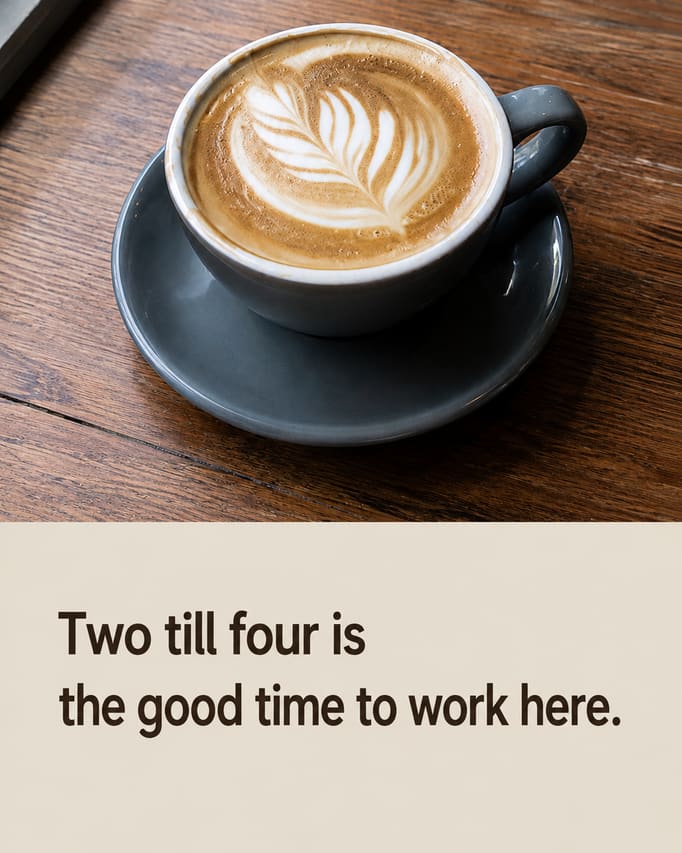
Layout Pro
The words and the panels go on top. The photograph underneath is exactly the one you took.
The quiet-hour post. It fills your deadest two hours.
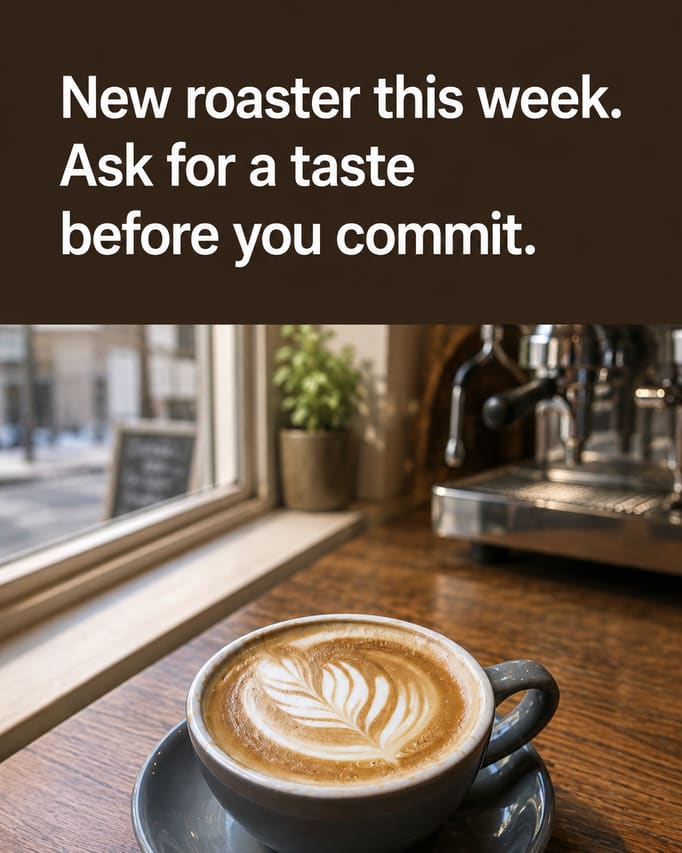
Visual Artist
Your subject is kept as it is, and the setting around it is replaced.
The product post. Same drink, a setting that reads as your place.
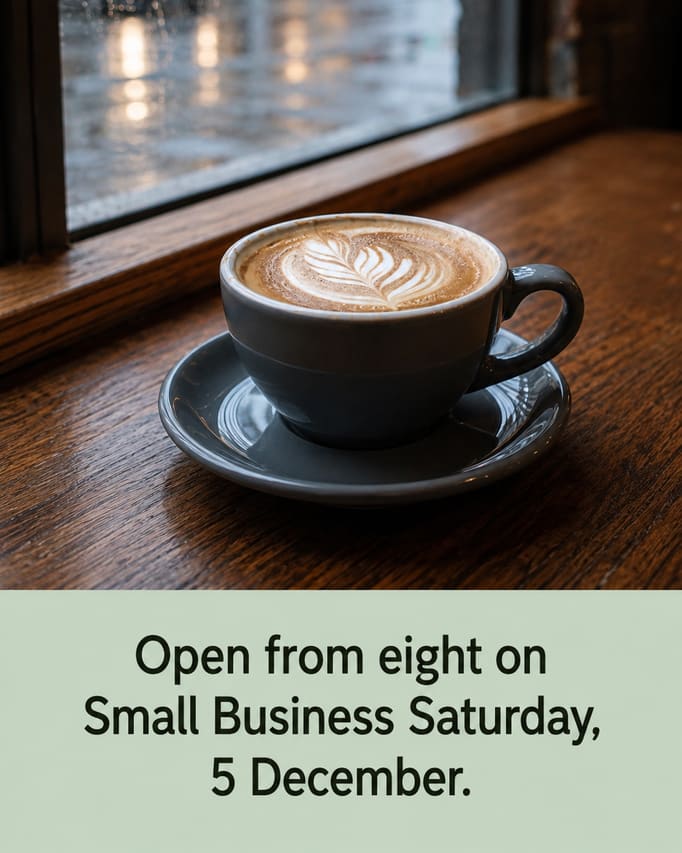
Image Maestro
Your subject is locked, then a new scene is built around it from a different angle.
The date post, written in November and scheduled for December.
Illustrative examples, generated rather than photographed in a real business.
One post, whichever you pick.
Where it stops being three posts and starts being a campaign
The one that matters to a café is the autumn switch: the clocks-go-back post, the seasonal menu launch in the first week of November, the Small Business Saturday one, the Christmas hours one. Four posts across six weeks, all of them obvious in September and none of them written in November, because November is when you are busiest. A campaign is that sequence built once and then queued, the difference between knowing what to do and having done it.
Sources
Where the numbers in this guide come from
Where a figure is somebody else's published work, it is linked so you can check it. Where a rule is stated, the link goes to the legislation or the regulator rather than to an article about it.
-
24,810 unlicensed restaurants and cafés
-
11,456 branded coffee shop outlets
-
Displaying the food hygiene rating is a legal requirement in Wales and Northern Ireland and voluntary in England
-
Natasha's Law: prepacked-for-direct-sale food needs a full ingredients list with the 14 allergens emphasised
Or let it write them for you.
SocialPostxr takes a photo and a line about your business and gives you three finished posts to pick from. The free plan needs no card.