For landscapers & gardeners
Social media for a gardener, in a trade built on before and after
You produce the most dramatic transformations of any trade in the country and most of them are photographed at midday from the middle of the lawn, which is the one angle and the one hour that flatten everything. Fixing that is free.
01 · Plan the year
The year, which for once is genuinely the weather
This is the only trade on the site where the calendar is not a marketing construct, the work physically cannot happen at the wrong time of year. That makes planning easy and makes being early absolutely decisive, because everybody rings on the same first warm weekend of spring.
-
Late summer, August and September
Hedge cutting comes back into play once nesting is over, and turf laid in early autumn establishes better than turf laid in May.
Post From mid-August, and explain why autumn turf is the better buy. It is true, it is counterintuitive, and it fills your quietest month.
-
Leaf fall and the autumn tidy, October and November
Gutters, leaves, cutting back, and the last chance to plant bulbs for spring.
Post From late September. Bulbs are the classic post, plant them now, see them in March.
-
Winter, December to February
The season most gardeners write off, and the season when hard landscaping, fencing, tree work and design consultations are best done and least contested.
Post Throughout, and say plainly that this is the right time for a patio or a fence. Most customers assume you are simply unavailable.
-
Storm season, roughly November to February
Fence panels, blown-over trees and waterlogged lawns. Demand arrives all at once and goes to whoever answers.
Post Before each named storm, not after. Check your posts, check your trees, and know who to ring.
-
The first warm weekend, usually March or April
The single biggest enquiry spike of your year, and it is over in about ten days. Whoever is visible that week takes the season.
Post Have it written in February. This one post is worth more than any other you will make.
-
The nesting season, 1 March to 31 August
Not a legal closed season for garden work, but the window in which most active nests are found, and it changes what you can safely cut.
Post Early March, explaining what you will and will not do and why. It is a genuine trust signal and almost nobody in the trade uses it.
-
The Chelsea Flower Show, late May
A week when the whole country is briefly interested in gardens and every plant on television gets searched for.
Post That week, tied to something you have actually planted locally rather than to the show itself.
-
Hosepipe bans and dry spells, June to August
Restrictions are declared by individual water companies, so they are regional and they are news where they happen.
Post As soon as your own supplier announces one. Drought-tolerant planting and how to keep a new lawn alive legally.
How to actually do the planning
- Have the first-warm-weekend post written by the end of February. It is the highest-value forty minutes of the year and it cannot be written on the day, because on the day you are on a job with no signal.
- Post the season before the season. Autumn turf in August, bulbs in September, hard landscaping in November, design consultations in January. Each one fills a month everybody else leaves empty.
- Photograph every job twice, the day you start and the day you finish, from the same spot. That is the whole content strategy for this trade and everything else is decoration.
02 · What to post
Eight things you could photograph this week
-
The same corner, day one and day five
Stand in exactly the same place. Gardens are the most dramatic before-and-after in any trade and the effect is entirely destroyed by moving three feet.
-
One plant, named
What it is, where it likes to be, when it flowers. It is the most saved and most shared thing a gardener posts and it costs nothing.
-
The hedge you would not cut
A nest, in June. Explaining why you left it does more for your reputation than the job you did next door.
-
Where the waste goes
The tip, the licence, the transfer note. Fly-tipping is the trade's reputational problem and being explicit is a genuine differentiator.
-
What a day actually costs
A day rate, and what a day covers. Gardening is the trade where customers have the least idea, which is why so many enquiries go nowhere.
-
The tool nobody has heard of
A border spade, a mattock, a long-reach hedge trimmer. Short, watchable, and it makes the work look like a craft, which it is.
-
Winter work, in November
Fencing, patios, tree work. Say it out loud, most customers genuinely believe you stop in October.
-
A lawn, over a season
Same lawn, four photographs, March to September. The best argument for a maintenance contract that exists.
03 · How often
How often, realistically
Two or three a week through the season and one a week through the winter. The winter posts matter more than they look, because January is when next year's regular contracts are decided.
Photograph at the start and the end of every job without exception. It takes a minute, it costs nothing, and it is the only trade where a single pair of photographs can be a whole post with no writing at all.
Do the writing on a wet day. There are enough of them and you will be glad of the bank of posts in April.
04 · Take a better photograph
How to photograph a garden so the work shows
Gardens are hard to photograph for a reason that has nothing to do with skill: bright overhead sun at midday flattens everything and burns the greens out, and that is exactly when you are finishing. The pair below is the same garden the same day. The only differences are the hour, the spot and what was left lying around.
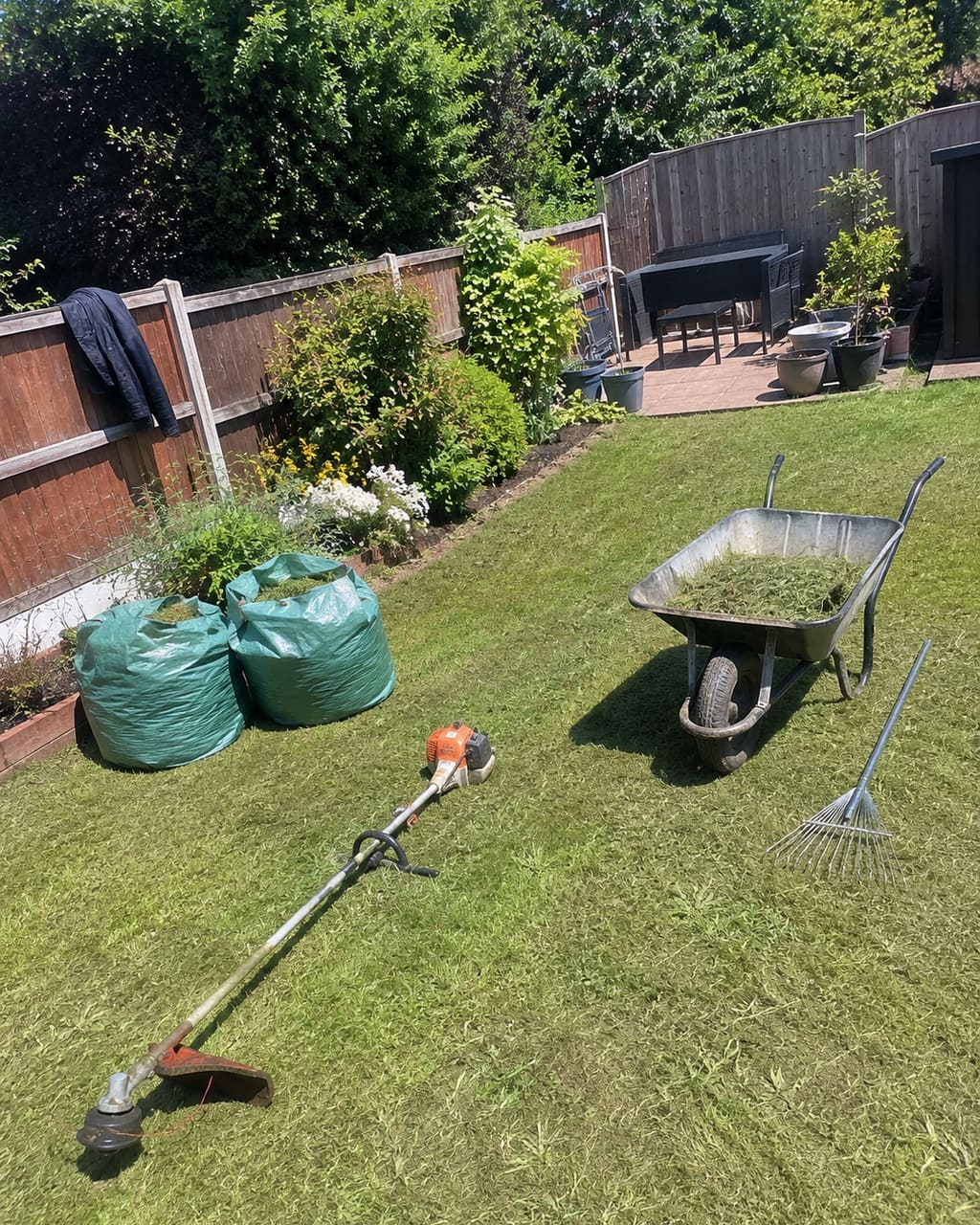
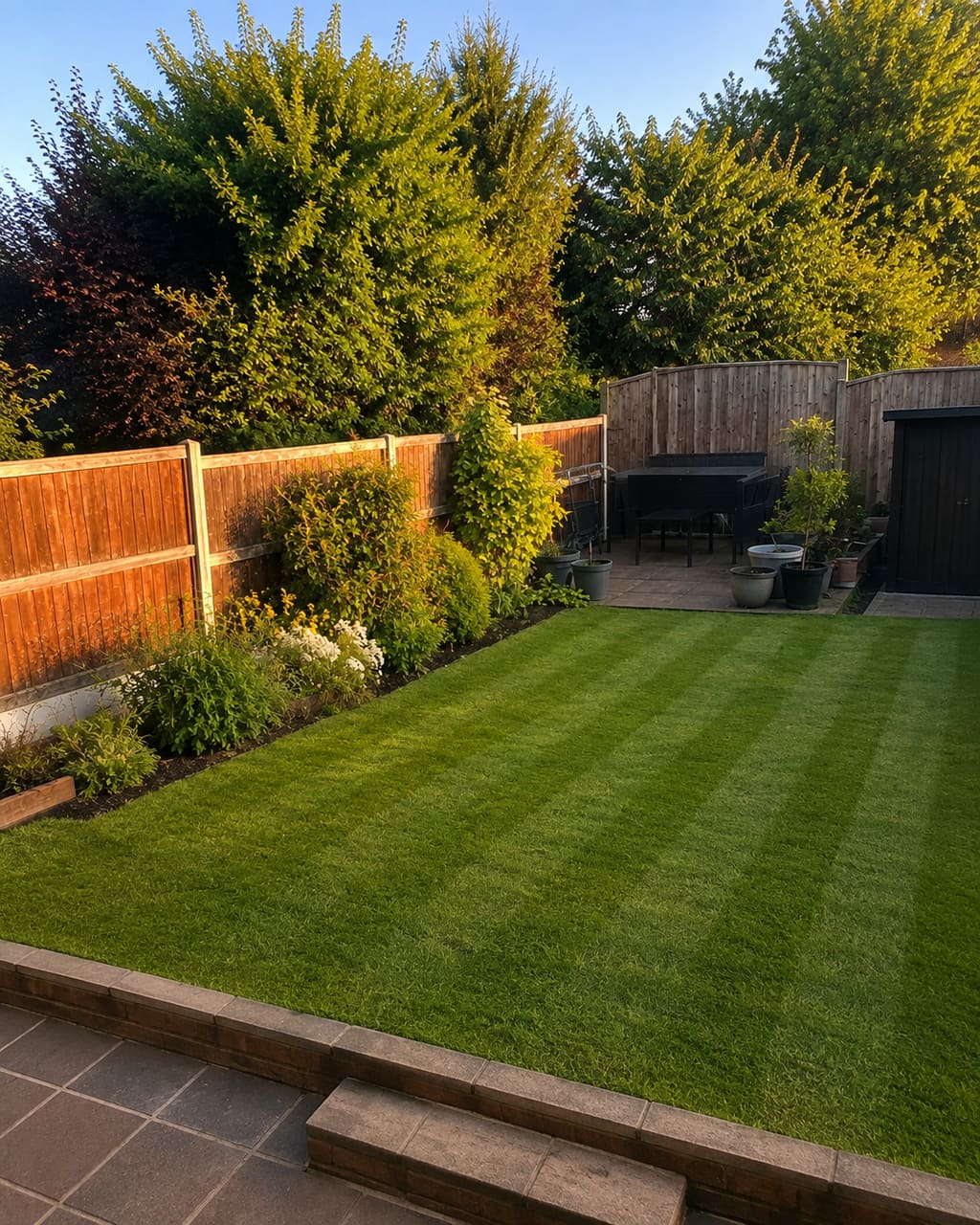
Illustrative examples, generated rather than photographed in a real business.
-
Shoot early or late, never at noon
Midday sun comes straight down: no shadows, no shape, and green foliage goes to a white glare that a phone cannot recover. The last hour before you pack up is nearly always the best light of your day. If you must shoot at noon, find shade or wait for cloud, a bright overcast day is genuinely the best garden light there is.
-
Stand where a person stands
Shoot from the back door, the patio or the kitchen window, the place the customer actually looks at the garden from. A photograph taken from the middle of the lawn is a view nobody has ever had, and it is why so many finished-garden photographs feel oddly flat.
-
Same spot, both frames
As with every before-and-after: mark where you stood, and stand there again. In a garden this is harder than it sounds because the whole place has changed. Photograph a fixed thing, the corner of the shed, the back step, in both frames and the comparison becomes undeniable.
-
Get the barrow out of the picture
Tools, the barrow, bags of waste, a coat over a fence. They read as 'unfinished' even when the job is done. Two minutes of clearing the frame, and take the photograph before you load the van rather than after, while the light is still there.
-
Include something for scale
A path, a step, a bench, a door. A border with nothing recognisable next to it could be two metres or twenty, and a customer cannot picture their own garden from it. Scale is what makes a photograph persuasive rather than pretty.
05 · The UK part
The British specifics, stated properly
- Nesting birds: under section 1 of the Wildlife and Countryside Act 1981 it is an offence to intentionally take, damage or destroy the nest of any wild bird while that nest is in use or being built. There is no legal closed season for garden work, the offence applies whenever an active nest is present, including outside March to August. The commonly quoted 1 March to 31 August window comes from a different rule: the Management of Hedgerows (England) Regulations 2024, which restrict cutting hedgerows on or beside agricultural land in that period. Hedges within a private dwelling's curtilage are exempt from that ban, but the nesting offence still applies to them.
- Waste carrier registration: if you take waste away from a customer's garden you must be registered with the Environment Agency in England, or the equivalent regulator in the other UK nations. Green waste you created yourself normally needs only free lower-tier registration; the moment you also carry rubble, slabs, removed fencing or rubbish the customer already had, you need upper-tier registration. Registration is separate from your duty of care, the waste still has to go to a permitted site. Say which you hold. It is a real differentiator in a trade with a fly-tipping problem.
- Japanese knotweed: it is not illegal to have it and you are not required to remove it. It is an offence under section 14 of the same Act to plant it or cause it to grow in the wild, you must stop it spreading off the property, and knotweed and contaminated soil are controlled waste that must go via a registered carrier to a permitted site. Getting this right in public marks you out immediately, because most of what is written about it is wrong.
- Hosepipe bans are declared by individual water companies, not nationally, so they are a regional event and a regional content opportunity. Knowing your own supplier's position is local knowledge nobody can fake.
- Tree work in a conservation area, or on a tree with a Tree Preservation Order, needs notice to or consent from the council. Explaining that before a customer asks is the single clearest signal that you are the professional rather than the man with a chainsaw.
06 · Mistakes
What not to do
- Before-and-afters shot from different places. In a garden the change is so large that a change of angle destroys the comparison entirely, it stops looking like the same place.
- Only posting between April and September. Winter is when hard landscaping is booked and when next season's maintenance contracts are decided, and a feed that goes dead in October starts the spring from nothing.
- Stock photographs of immaculate gardens that are not yours. Every gardener in the country can tell, and so can a surprising number of customers.
07 · And then, us
And then, the part we do
The lesson above is free and needs nothing but an hour's patience. This is the pitch, and it is one garden photographed once, in the good light. Nobody went back the next day. The difference across the row is how much the assistant rebuilds.
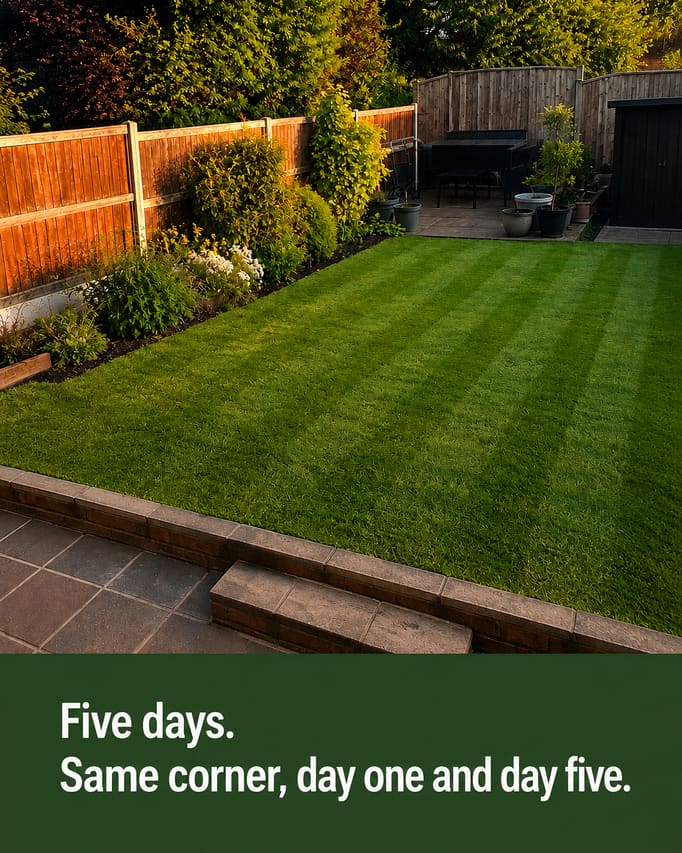
Layout Pro
The words and the panels go on top. The photograph underneath is exactly the one you took.
The transformation post. The format this whole trade is built on.
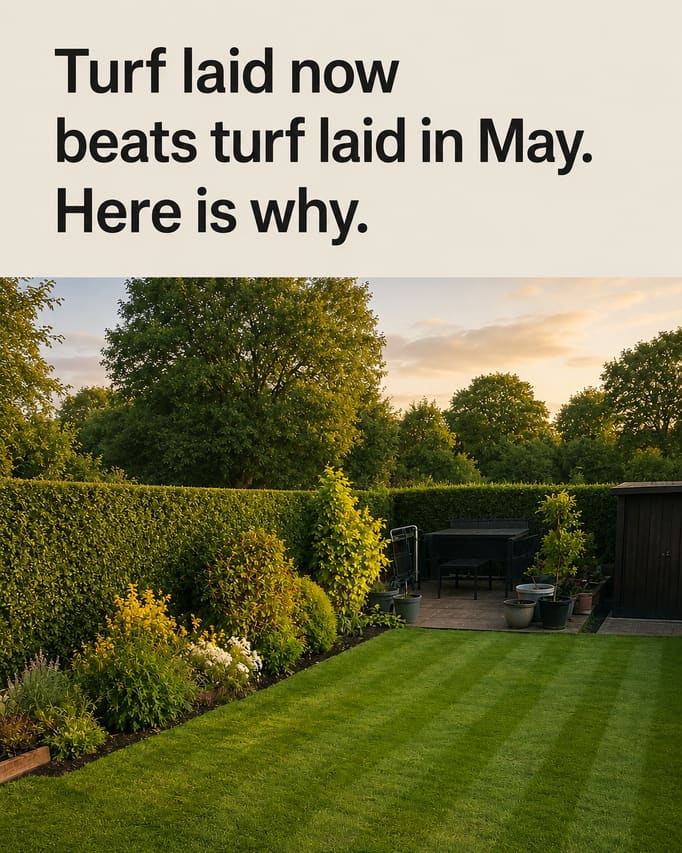
Visual Artist
Your subject is kept as it is, and the setting around it is replaced.
The counterintuitive post that fills your quiet month.
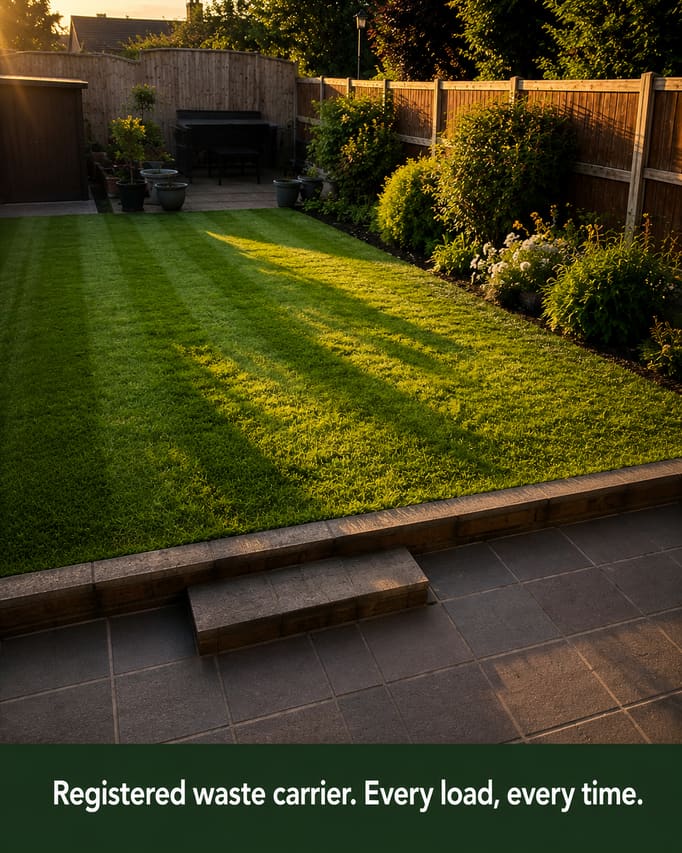
Image Maestro
Your subject is locked, then a new scene is built around it from a different angle.
The trust post. In a trade with a fly-tipping problem, worth saying.
Illustrative examples, generated rather than photographed in a real business.
One post, whichever you pick.
Where it stops being three posts and starts being a campaign
The one that decides a gardener's year is the fortnight either side of the first warm weekend in March, and it cannot be written in March. A campaign is that run built in February, the we-are-taking-bookings post, the what-a-day-costs post, the spring-tidy one, the maintenance-contract one, dated and queued so it goes out while you are already on a job with no signal and a full diary. Every gardener knows the spike is coming. Almost none of them are visible during it.
Sources
Where the numbers in this guide come from
Where a figure is somebody else's published work, it is linked so you can check it. Where a rule is stated, the link goes to the legislation or the regulator rather than to an article about it.
-
Around 24,702 landscaping services businesses
-
It is an offence to damage the nest of a wild bird while in use
-
Waste carrier registration is required to take waste away
Or let it write them for you.
SocialPostxr takes a photo and a line about your business and gives you three finished posts to pick from. The free plan needs no card.