For electricians
Social media for an electrician, written for the UK
Nearly everything published on this subject is American, which is why it talks about permits and never mentions Part P, an EICR or a competent person scheme. Here is the version that applies to you.
01 · Plan the year
The year, and where the work actually comes from
Electrical work has a long buying cycle: nobody needs an electrician until they urgently do. That makes the calendar less about seasonal demand and more about being the name already in someone's head, with three genuine seasonal spikes worth planning for.
-
The clocks go back, Sunday 25 October 2026
Outside lights, security lighting and porch lights all become visible problems on the same evening.
Post The week before, while people can still picture the dark walk from the car.
-
Storm season, October to February
Tripping RCDs, water in external sockets, garden lighting failing. Demand is reactive and it arrives all at once.
Post Before the weather, not after. "What to check before the first storm" outperforms "we fixed this after the storm" every single time.
-
Christmas lighting, from mid-November
Outdoor sockets, extension leads run through windows, and the annual crop of genuinely dangerous improvisation.
Post From the second week of November, as safety rather than as sales. It is a post people love to share.
-
The January rewiring and renovation window
Extensions and kitchen jobs are planned in January for spring, and the electrical first fix is booked long before the builder starts.
Post From the last week of December, aimed at homeowners planning rather than homeowners in trouble.
-
Spring and summer, April to August
Garden power, outbuildings, hot tubs, EV charge points. All discretionary, all bought when the weather turns.
Post From late March. This is where the year's higher-margin work lives.
-
Landlord EICR renewals, on a rolling five-year cycle
Legally required for rented homes in England, Scotland and Wales, which makes it a recurring, dated, searchable market.
Post Monthly, at landlords specifically. Most of them do not know the certificate has an expiry date until it has passed.
How to actually do the planning
- Split the year into two audiences: homeowners who are planning something, and landlords who have an obligation. The second group is smaller, easier to reach and worth far more per customer.
- Post the seasonal safety content two to three weeks before the season, not during it. During it, everybody is either fine or already on the phone to someone.
- One explaining post to every three job posts. The job posts prove you can do it; the explaining posts are the ones that get shared into a local group by somebody who is not your customer yet.
02 · What to post
Eight things you could photograph this week
-
The consumer unit, before and after
A rewireable fuse box next to a new board with RCBOs. It is the clearest visual argument in the trade and most people have never seen one.
-
What an EICR actually finds
One anonymised C2, what it means and what it cost to fix. Landlords search this constantly and get vague answers.
-
The bad job you inherited
No names, no address. Choc-blocks in a loft, a cooker on a ring final. It sells your value without selling anyone else's failure.
-
An EV charger install, start to finish
Four photographs and the load calculation in plain English. The people searching for this are usually ready to book.
-
Why the lights flicker
Answer a real question properly. The person who searches it either calls you or remembers you when something worse happens.
-
Your scheme registration
NICEIC, NAPIT or ELECSA, say which, and explain what notification under Part P means for the homeowner. Most do not know their extension needs it.
-
The tidy second fix
Level sockets, straight faceplates, labelled board. Trade craftsmanship photographs better than people expect and it is what referrals are made of.
-
How long you have been doing it
Once a quarter, quietly. Electrical work is bought on trust and years are the cheapest evidence you have.
03 · How often
How often, realistically
Two a week is enough, and the constraint is not ideas, it is that you are up a ladder. Take the photographs as you work and write them up in the van at lunch.
One explaining post to every three job posts. The job posts prove you can do it; the explaining posts are what get shared into a local Facebook group by someone who is not your customer yet.
Consistency matters more here than in most trades because the buying cycle is long. Nobody needs an electrician until they urgently do, and you want to be the one they already follow.
04 · Take a better photograph
How to photograph a board so the work shows
A consumer unit is a grey box on a white wall in a dark cupboard, which is about as unpromising a subject as exists. It is also the single most persuasive thing you own, because a tidy board is visible evidence of everything a customer cannot assess. The pair below is the same install.
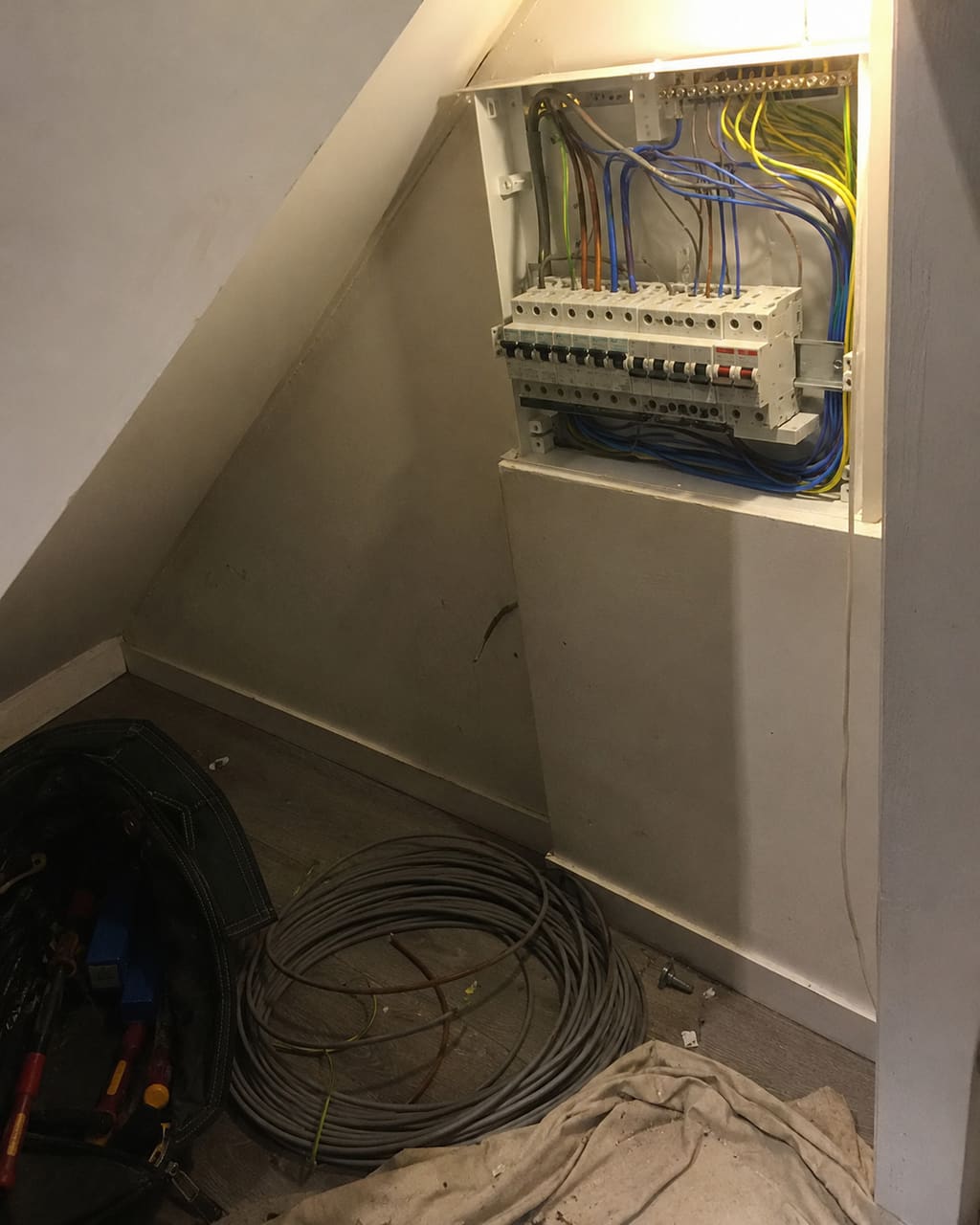
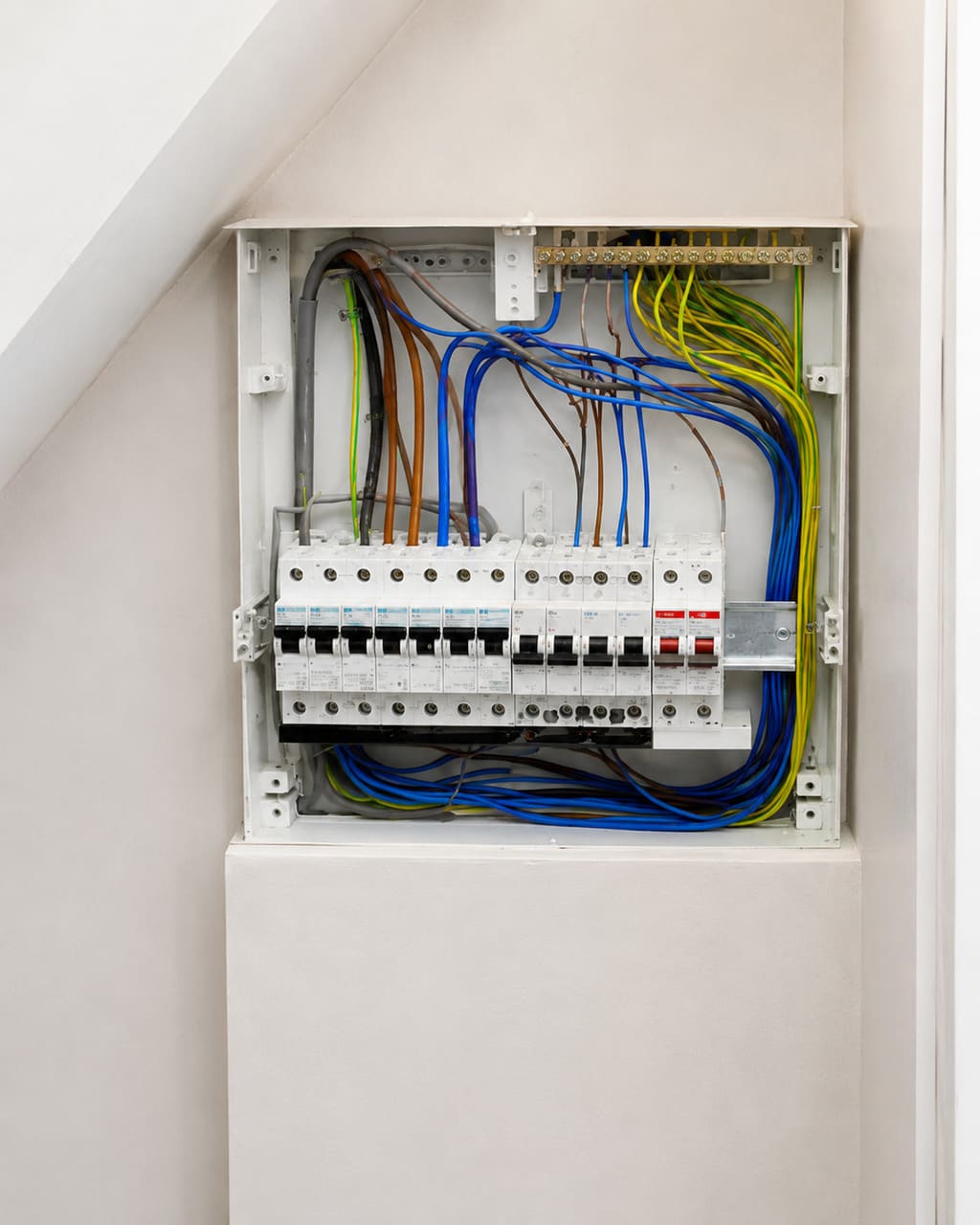
Illustrative examples, generated rather than photographed in a real business.
-
Square on, and level
A board is a rectangle full of rectangles. Shot from an angle it keystones, the labels stop being readable and the whole thing looks like a snap. Stand directly in front, phone flat to the wall, grid turned on. This one change does more than everything else here combined.
-
No flash, borrow the daylight
The flash bounces straight off a white enclosure and blows out the middle of the frame, which is the part you wanted. Open the cupboard, open whatever door is behind you, and let the room light do it. If it is genuinely dark, put a second phone's torch a metre to one side rather than beside the lens.
-
Make the labels readable
Half the value of the photograph is that someone can read "Kitchen sockets" and "Upstairs lights". Get close enough that the printing is legible on a phone screen, if you cannot read it at arm's length on your own phone, nobody scrolling will.
-
Clear the floor and the frame
Cable offcuts, knockouts, the old board leaning against the wall. It takes twenty seconds and it is the difference between a finished job and a job you photographed on the way past.
-
Always take the before
The rewireable fuse box, the burnt terminal, the choc-block in the loft. That photograph is worth ten of the finished board, and it exists for about four minutes before you take it out. Shoot first, work second.
05 · The UK part
The British specifics
- Part P notification is a building regulation for England and Wales, with no American equivalent. Explaining what it means for a homeowner's extension or new circuit is genuinely useful content that nobody currently in the results is writing.
- EICRs are legally required for rented homes in England, Scotland and Wales on a five-year cycle. Landlords are a repeat, searchable, date-driven market.
- Name your competent person scheme, NICEIC, NAPIT, ELECSA, or SELECT in Scotland. It is the trust signal in this market and it is checkable, which is what makes it worth saying.
- The 18th Edition and its amendments are the UK reference. Citing the American NEC, as several of the pages ranking today do, marks a page as irrelevant instantly.
- British housing stock is old and full of things Americans do not have: ring final circuits, rewireable fuse boards, back boxes chased into solid brick. Every one of those is a post that structurally cannot be written from Ohio.
06 · Mistakes
What not to do
- Posting only finished faceplates. They all look the same. The value is in the board, the fault and the explanation.
- Naming or shaming the last electrician. It reads badly and the trade is small.
- Quoting prices for work you have not seen. Post ranges and the factors that move them instead, it saves you the visit that was never going to convert.
07 · And then, us
And then, the part we do
Everything above costs nothing and needs no software. This is the pitch: the same board, the same photograph from section 04, three times over. What changes is how much of the picture the assistant is allowed to rebuild.
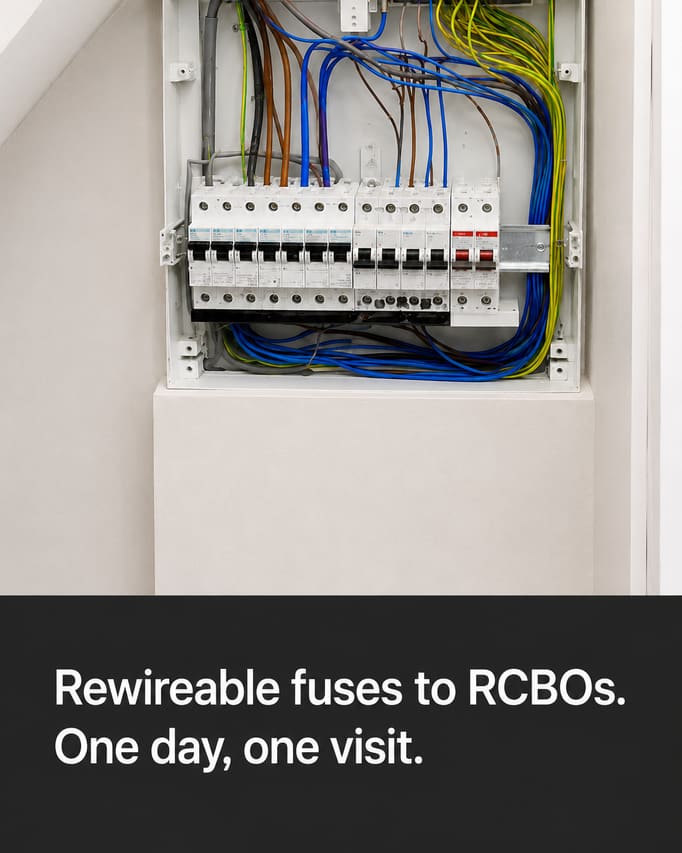
Layout Pro
The words and the panels go on top. The photograph underneath is exactly the one you took.
The job post. What it was, what it is, how long it took.
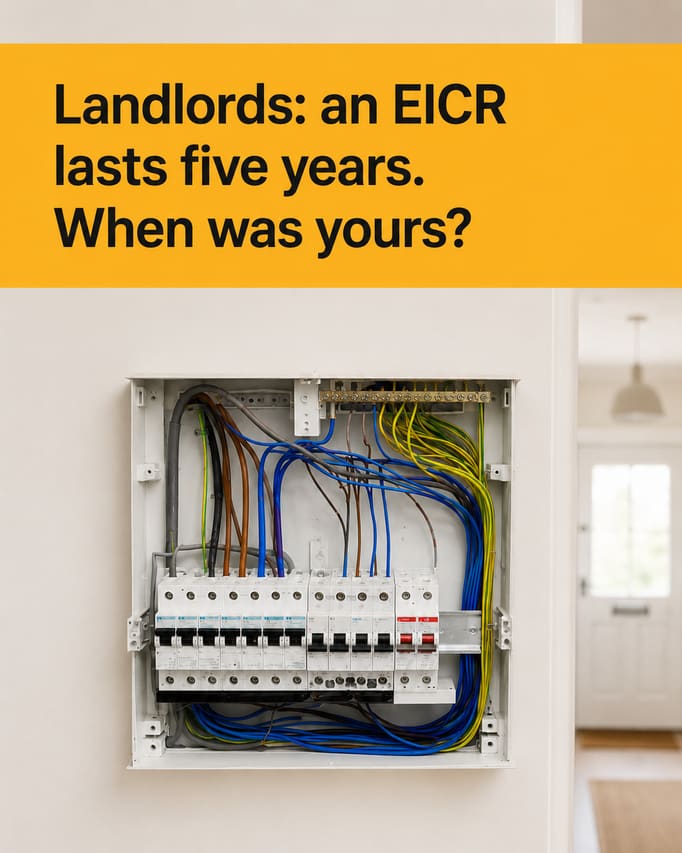
Visual Artist
Your subject is kept as it is, and the setting around it is replaced.
The landlord post. Same board, a background that lets the labels read.
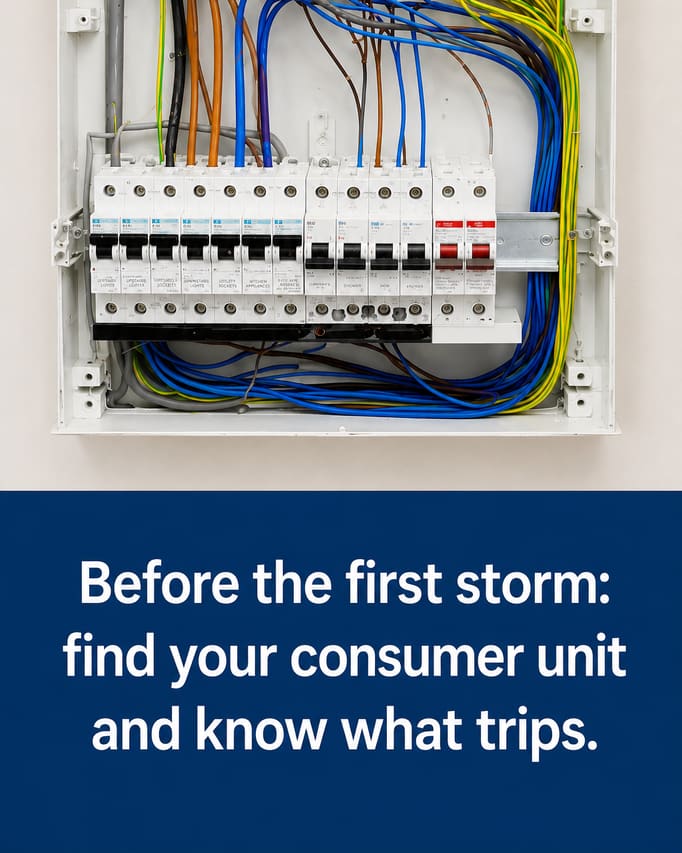
Image Maestro
Your subject is locked, then a new scene is built around it from a different angle.
The safety post. The kind that gets shared into local groups.
Illustrative examples, generated rather than photographed in a real business.
One post, whichever you pick.
Where it stops being three posts and starts being a campaign
The one worth having is the autumn safety run: the outside-lighting post the week the clocks go back, the storm-check post a fortnight later, the Christmas lighting one in mid-November. Three posts, three weeks apart, written on one evening in September and then out of your hands. They are the posts that get shared by people who are not your customers, which is the only free distribution this trade has.
Sources
Where the numbers in this guide come from
Where a figure is somebody else's published work, it is linked so you can check it. Where a rule is stated, the link goes to the legislation or the regulator rather than to an article about it.
-
Around 49,885 electrical contracting businesses
-
EICRs required on a five-year cycle for rented homes
Or let it write them for you.
SocialPostxr takes a photo and a line about your business and gives you three finished posts to pick from. The free plan needs no card.