For driving instructors
Social media for a driving instructor, which is mostly one photograph done well
There are 43,334 approved driving instructors on the DVSA register and almost every one of them is a sole trader with a waiting list they cannot predict and no marketing at all. You have one of the strongest content formats in the country, the pass photo, and it is usually taken badly, into the sun, in a car park.
01 · Plan the year
The year a learner actually lives in
Your demand is driven by birthdays, school terms and exam results, none of which are evenly spread. The parents booking on a pupil's behalf are planning weeks ahead; the pupils themselves are planning about four days ahead. Post to both.
-
Results season, mid to late August
The biggest enquiry window of the year. Sixth-formers and school leavers with a summer of freedom and a parent willing to pay for lessons.
Post From the first week of August, before results day rather than after. By results day the good instructors are already full.
-
Term starting, September
New college and sixth-form intakes, and a wave of seventeenth birthdays.
Post Early September, aimed at parents. They are the ones who book and pay.
-
The clocks go back, Sunday 25 October 2026
Night driving becomes possible after school for the first time, and it is the part of learning most pupils are quietly frightened of.
Post The week before. Night lessons are a genuinely useful thing to offer and hardly anybody advertises them.
-
Winter conditions, November to February
Ice, spray, low sun and dark. It is the best teaching content of the year and the hardest to book lessons in.
Post Throughout, as short useful clips. Skid recovery, stopping distances, demisting a windscreen properly.
-
The Christmas holidays
Two weeks when pupils are free all day and most instructors take the whole period off.
Post Early December. Intensive courses over the holidays sell well and there is almost no competition for the slot.
-
January
New year, new resolutions, and a genuine spike in people finally starting.
Post From the 28th of December, with your first available date. Availability is the whole message in January.
-
Easter and the spring half term
Intensive course season, and the run-up to exam study when lessons get paused.
Post Four weeks before each, because intensive courses need a block booked in advance.
-
Seventeenth birthdays, all year
You can apply for a provisional licence at fifteen years and nine months and drive from seventeen. Every month there is a fresh cohort.
Post Monthly. It is the same post each time and it works every time.
How to actually do the planning
- Post at parents in August, September and January, and at pupils the rest of the time. They want different things: parents want safety, reliability and a price; pupils want availability and a person who is not frightening.
- Lead with availability whenever you have it and with the waiting time whenever you do not. "Next slot 6 October" is a better post than any testimonial, and it is honest either way.
- Take a pass photo every single time and ask before the test, not after. Asking in the car park while they are still shaking is why so many of them come out badly.
02 · What to post
Eight things you could photograph this week
-
The pass photo, done properly
The one format that outperforms everything else you will ever post. Name, date, and how many attempts, including the ones that took three.
-
The manoeuvre, from the passenger seat
Bay parking or parallel, in thirty seconds, narrated. It is the most saved thing an instructor posts.
-
The mistake that fails most tests
Observations at junctions, not the manoeuvre everybody worries about. Say what actually costs people the test.
-
Your next free slot
With the date. Nothing else you post converts as directly, and it takes ten seconds.
-
What the theory test really involves
Multiple choice and hazard perception, the pass marks, and that the certificate lasts two years. Most people find that last one out too late.
-
A roundabout in your town, explained
The specific local one everybody gets wrong. It is the most local post possible and it will be shared by people who passed years ago.
-
One Highway Code rule a week
Especially the hierarchy of road users introduced in January 2022, which a lot of qualified drivers still do not know about.
-
The pupil who took four attempts
With their permission. It is the post that reaches the person who has failed twice and is about to give up.
03 · How often
How often, realistically
Two or three a week, and one of them is a pass photo whenever you have one. You do not need to invent content, your diary produces it.
Do the filming between lessons in the car, not at home in the evening. A thirty-second explanation filmed in the passenger seat with the pupil's permission is worth more than anything you would script.
The quiet weeks are exam season and the fortnight before Christmas. Use them to build the January and August posts, which are the two that fill the year.
04 · Take a better photograph
How to take a pass photo that people actually stop for
This is the most important photograph in your business and it is almost always taken in the worst possible conditions: a test centre car park, immediately after, into whatever light there is, with a nervous person holding a piece of paper. The pair below is the same pupil and the same car, two minutes apart.
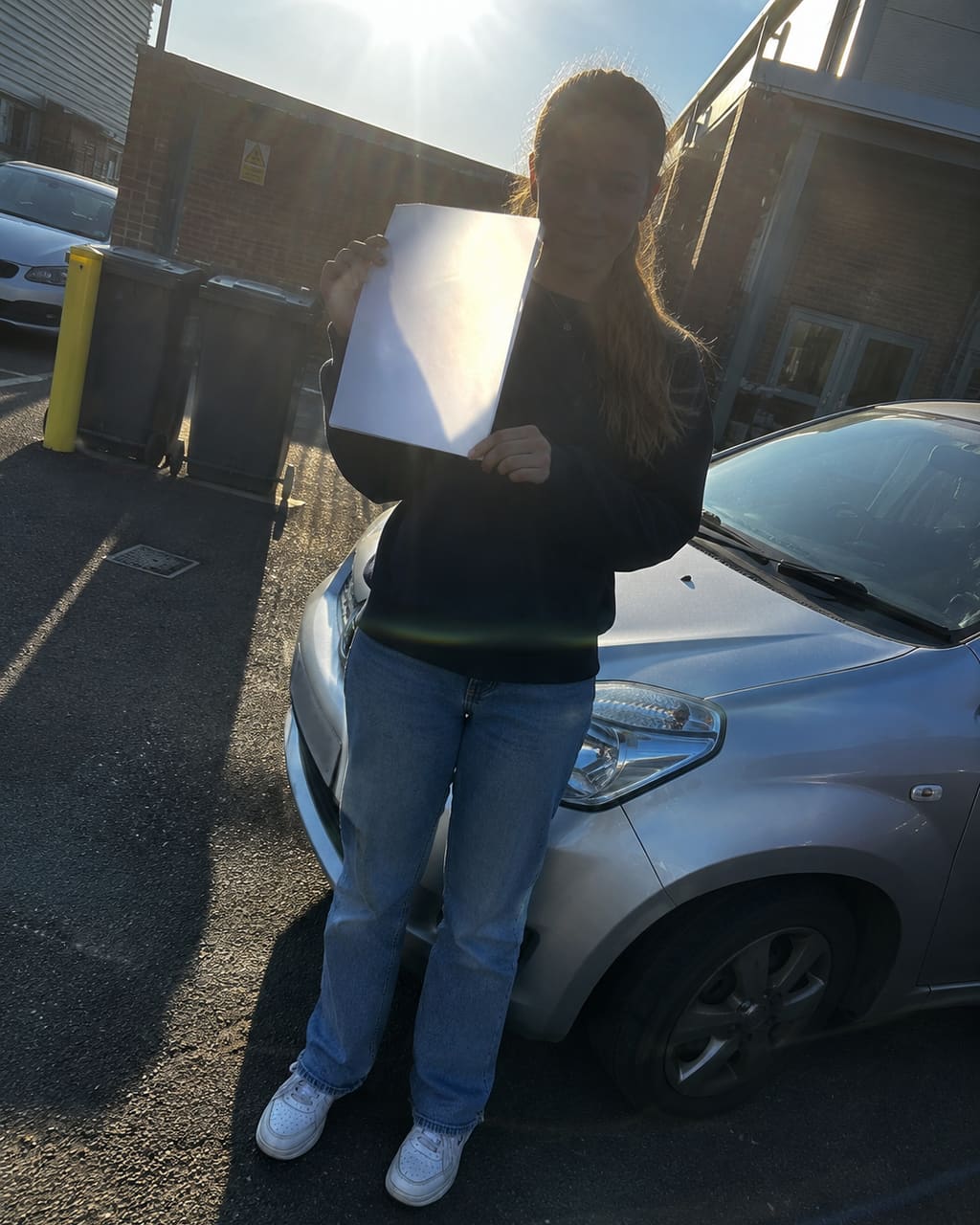
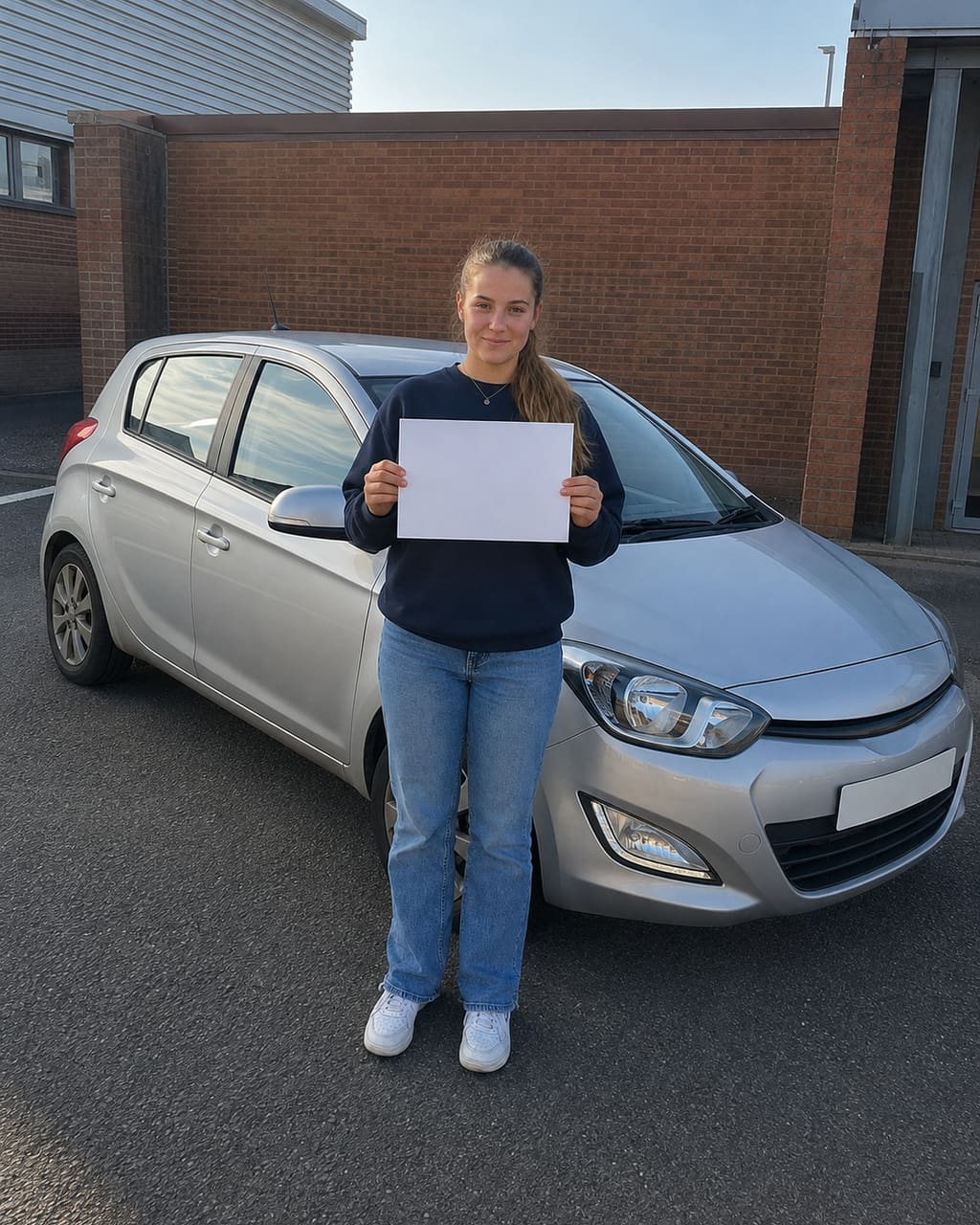
Illustrative examples, generated rather than photographed in a real business.
-
Put the sun behind you, not behind them
Shooting towards the sun turns your pupil into a silhouette and the certificate into a white rectangle. Walk round the car so the light is over your shoulder and onto their face. Two steps. This one change fixes more pass photos than everything else here put together.
-
Take a step back and get the car in
The car is your advertising, your name is on it. Too many of the pass photos posted have the roof cut off and the door sign out of frame. Step back until you can see the pupil, the certificate and the side of the car with the branding on it, then hold the phone at chest height rather than at eye level so the car does not look like it is falling away.
-
Check what is behind them
Test centre car parks are full of bins, bollards and other people's cars. Move two metres. The background is the difference between a photograph that looks like a moment and one that looks like a receipt.
-
Certificate flat to the camera
Held at an angle it is unreadable and it catches the light. Ask them to hold it square on and slightly away from their body, and take one with it and one without, the one without is usually the better photograph and the one with is the one that proves it.
-
Ask before the test, not after
Not a lighting tip, and the most important one. Ask at the start of the last lesson whether they are happy to be photographed and posted if they pass. They will nearly always say yes, they will have thought about what they are wearing, and you will not be asking a shaking eighteen-year-old for a favour in a car park.
05 · The UK part
The British specifics
- Only approved driving instructors, who display a green badge in the windscreen, and trainees with a licence, who display a pink one, may legally charge for lessons. The register is held by the ADI Registrar at DVSA. Saying which you hold, and what the badge means, is useful to every parent and almost nobody explains it.
- A theory test pass certificate is valid for two years, and if it expires the theory test has to be taken again. This catches people out constantly. Note that the Department for Transport consulted in 2026 on a minimum learning period and on whether that two-year validity should change, so it is worth saying 'currently'.
- Learners have been allowed to take motorway lessons in Great Britain since 4 June 2018, with an approved instructor in a dual-control car. It is voluntary and it is the instructor's call when the pupil is ready. A surprising number of parents still believe it is not allowed.
- The Highway Code changed on 29 January 2022 to introduce a hierarchy of road users, rules H1, H2 and H3. It applies in England, Scotland and Wales; Northern Ireland has its own Highway Code. Most qualified drivers have never read it, which makes it excellent content for an audience far wider than your pupils.
- DVSA's Ready to Pass? campaign is a free official resource, with a learning sequence, reflective questions and an instructor toolkit. Pointing pupils at it costs you nothing and marks you as the professional in the conversation.
06 · Mistakes
What not to do
- Pass photos shot into the sun in a test centre car park. It is the most valuable photograph you take and it is routinely the worst one on your feed.
- Posting only the first-time passes. The person most likely to book you is the one who has already failed twice, and a feed of nothing but first-time passes tells them you are not for them.
- Never saying when you are free. Instructors are chosen on availability more than on anything else, and a feed with no dates in it makes someone ring the next name on the list.
07 · And then, us
And then, the part we do
The lesson above needs two steps and a bit of nerve. This is the pitch, and all three start from that one photograph in the car park. The pupil went home. What changes across the row is how far you let the assistant go.
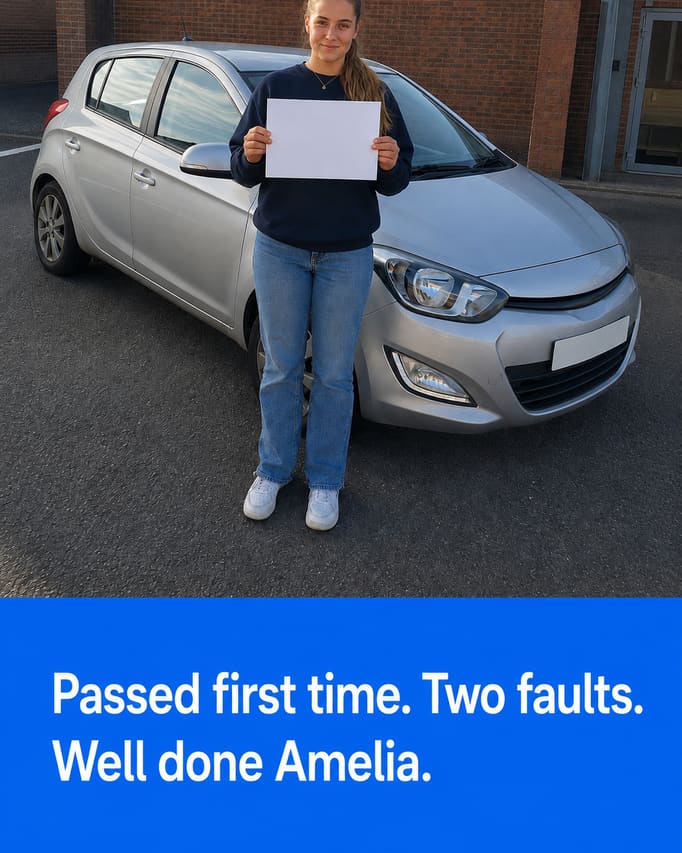
Layout Pro
The words and the panels go on top. The photograph underneath is exactly the one you took.
The pass post. The format, in the shape a feed wants.
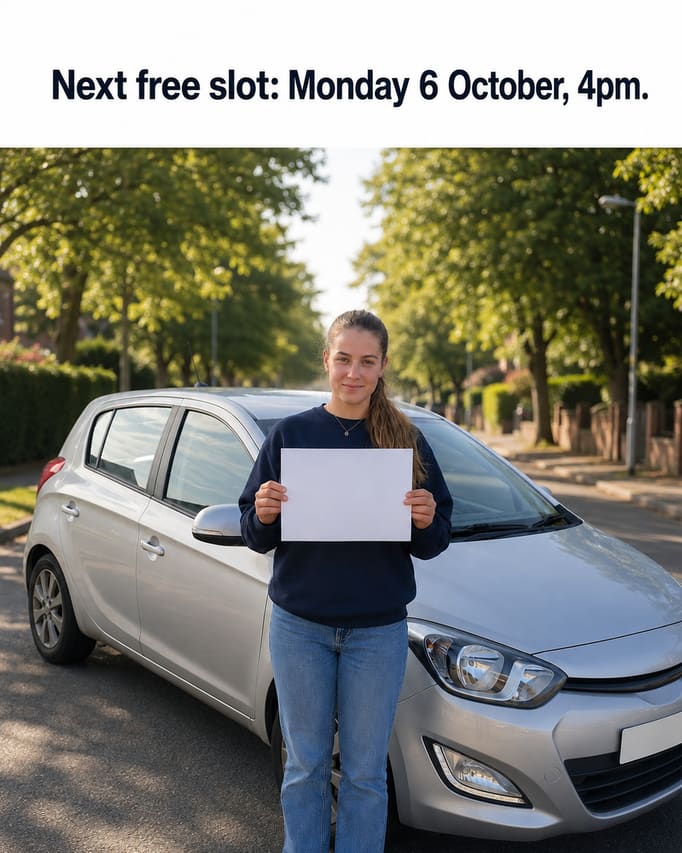
Visual Artist
Your subject is kept as it is, and the setting around it is replaced.
The availability post. It converts better than anything else you write.
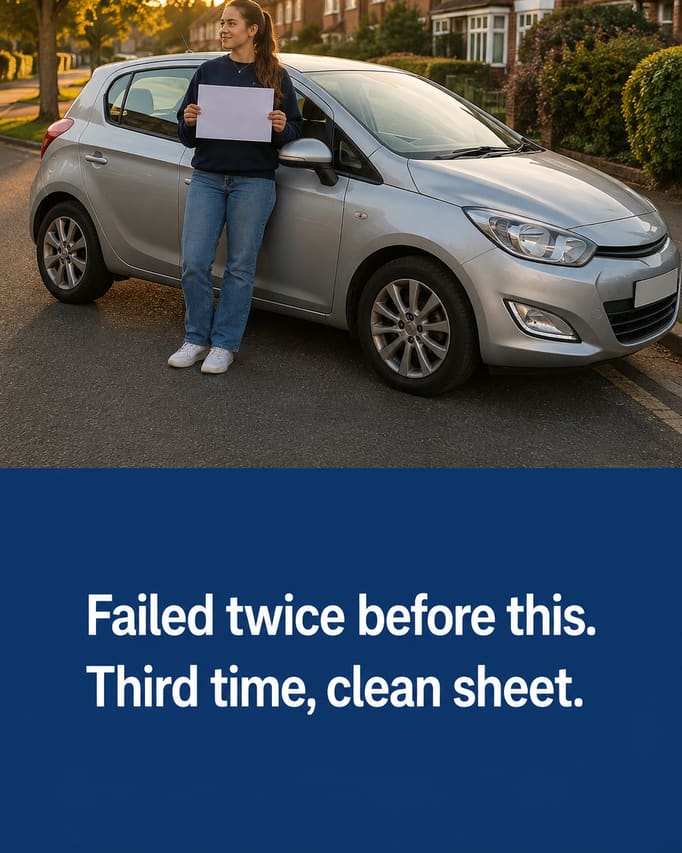
Image Maestro
Your subject is locked, then a new scene is built around it from a different angle.
The post that reaches the person who is about to give up.
Illustrative examples, generated rather than photographed in a real business.
One post, whichever you pick.
Where it stops being three posts and starts being a campaign
August is the whole year for a driving instructor and it starts before results day, not after. A campaign is that fortnight written in July, the we-are-taking-bookings post, the what-lessons-cost post, the how-long-it-really-takes post, the last-slots one, dated and queued while you are doing ten hours a day in a car. The instructors who are full by September are not better teachers than the ones who are not. They were visible in the first week of August.
Sources
Where the numbers in this guide come from
Where a figure is somebody else's published work, it is linked so you can check it. Where a rule is stated, the link goes to the legislation or the regulator rather than to an article about it.
-
43,334 approved driving instructors on the register
-
Motorway lessons permitted with an approved instructor
-
The hierarchy of road users introduced to The Highway Code
Or let it write them for you.
SocialPostxr takes a photo and a line about your business and gives you three finished posts to pick from. The free plan needs no card.