For garages & MOT centres
Social media for an independent garage, against a main dealer's budget
There are around 43,000 vehicle repair businesses in the UK and 23,316 active MOT stations in Great Britain. Almost all of them compete on trust with a franchised dealer that has a marketing department, and almost none of them use the one thing that beats it, which is being visibly honest in public.
01 · Plan the year
The year, and the two months that run it
This trade has the most legible calendar of any on the site, because the government set it. Number plates change in March and September, so the cars registered then come up for their first MOT three years later in the same months, and every MOT after that falls on the same anniversary. The cluster never breaks.
-
September plate change and MOT peak
One of the two busiest months of your year, driven by every 'new-plate September' three years and more ago.
Post From mid-August, with your actual booking availability. People book an MOT the week they remember it.
-
The clocks go back, Sunday 25 October 2026
Half the country discovers a blown bulb on the same evening. Lights, wipers and washer fluid are the three cheapest jobs you will ever sell.
Post The Friday before. It is genuinely useful, it is shared, and it converts the same week.
-
The first cold snap, late October to November
Batteries fail on the first properly cold morning, not gradually. Free battery checks are the most direct lead generator in the trade.
Post Mid-October, before the failures rather than after.
-
Christmas travel, the week of the 15th of December
Everybody drives further than usual on roads they do not know, and nobody has checked their tyres.
Post Early December. Tyres, coolant, a spare bulb kit. Say what you are open over the period while you are at it.
-
March plate change and the second MOT peak
The other half of your year, and it arrives at the same time as the pothole season.
Post From mid-February. Same as September: availability, plainly stated.
-
Pothole season, February to April
Alloys, tracking, suspension. It is the most reliably British source of unplanned work there is.
Post From February, and offer a free tracking check, it is two minutes and it finds paid work most times you do it.
-
The summer holidays, July and August
Pre-holiday checks before people drive to Cornwall or across France, plus air conditioning regas season.
Post From mid-June. Air con is a service almost nobody thinks about until they are sitting in traffic on the M5.
How to actually do the planning
- Treat March and September as campaigns rather than as busy months. Start posting a month before each and you are booked before your competitor has noticed.
- Everything else in the year is a check: lights in October, batteries in November, tyres in December, tracking in February, air conditioning in June. Five posts, five obvious moments, and each one finds paid work.
- Point people at the free DVSA reminder service and the free MOT history check on GOV.UK. Sending someone to a government website instead of selling to them is the single most trust-building thing a garage can post, and it costs you nothing because they still have to book somewhere.
02 · What to post
Eight things you could photograph this week
-
The part that came off
A shredded belt, a corroded brake pipe, a pad worn to the backing. Nothing explains a bill like the object that caused it, and no other trade has objects this good.
-
What an MOT actually tests
The list, plainly. Most people think it is a safety inspection of the whole car and are then furious when a clutch fails three weeks later.
-
Advisory versus fail
The single most misunderstood thing in the trade. Explaining it well is worth more than any offer you could run.
-
The job you talked someone out of
"It has got another year in it." This is the most powerful post an independent garage can make, and a franchised dealer structurally cannot make it.
-
Your tester, by name
Years in the trade, what they drive, what they specialise in. People choose a garage because of a person.
-
The courtesy car and the waiting room
Boring, and it is the actual deciding factor for anyone booking a full day's work.
-
A ten-second walkaround
Tyre tread with a 20p coin, a bulb check with a wall, oil on the dipstick. Useful enough to save and share.
-
What the warning light means
One light per post. There is enormous search demand for this and most of the answers online are American and about different cars.
03 · How often
How often, realistically
Two or three a week, and let one of them always be a part in your hand. That format needs no writing and no staging and it is the most persuasive thing you own.
Weight it heavily to February to March and August to September. Those four months matter far more than the rest of the year, and it is easy to post the same way right through it.
Write the explaining posts once and reuse them. An honest explanation of advisories versus failures is as true next March as it is this one, and re-posting it every plate change is not laziness, it is a service.
04 · Take a better photograph
How to photograph a workshop so it looks like a business
Workshops photograph badly for two specific reasons: fluorescent strip lights, which go green on a phone camera, and clutter, which a human eye edits out and a camera does not. Both are free to fix. The pair below is the same car, ten minutes apart.
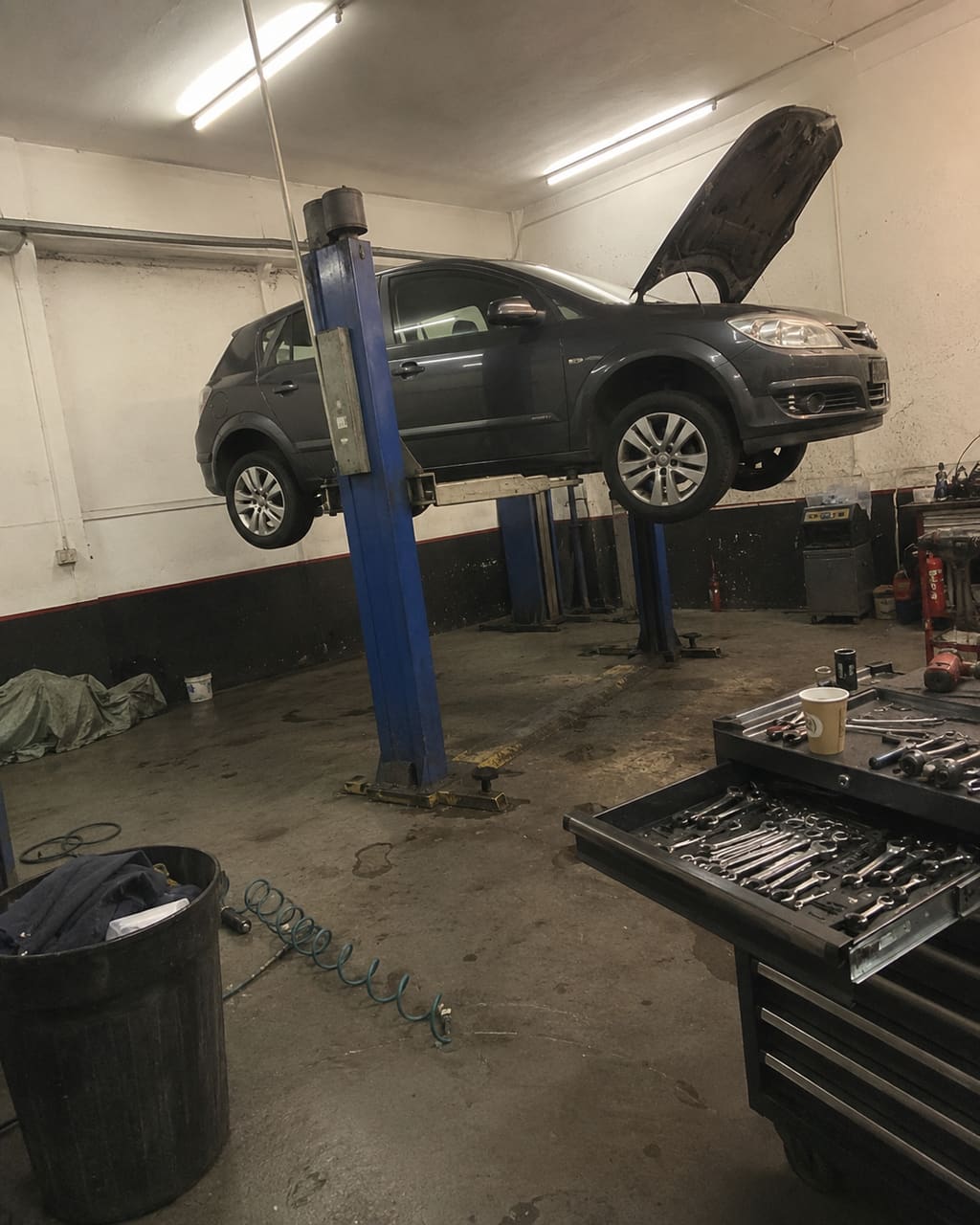
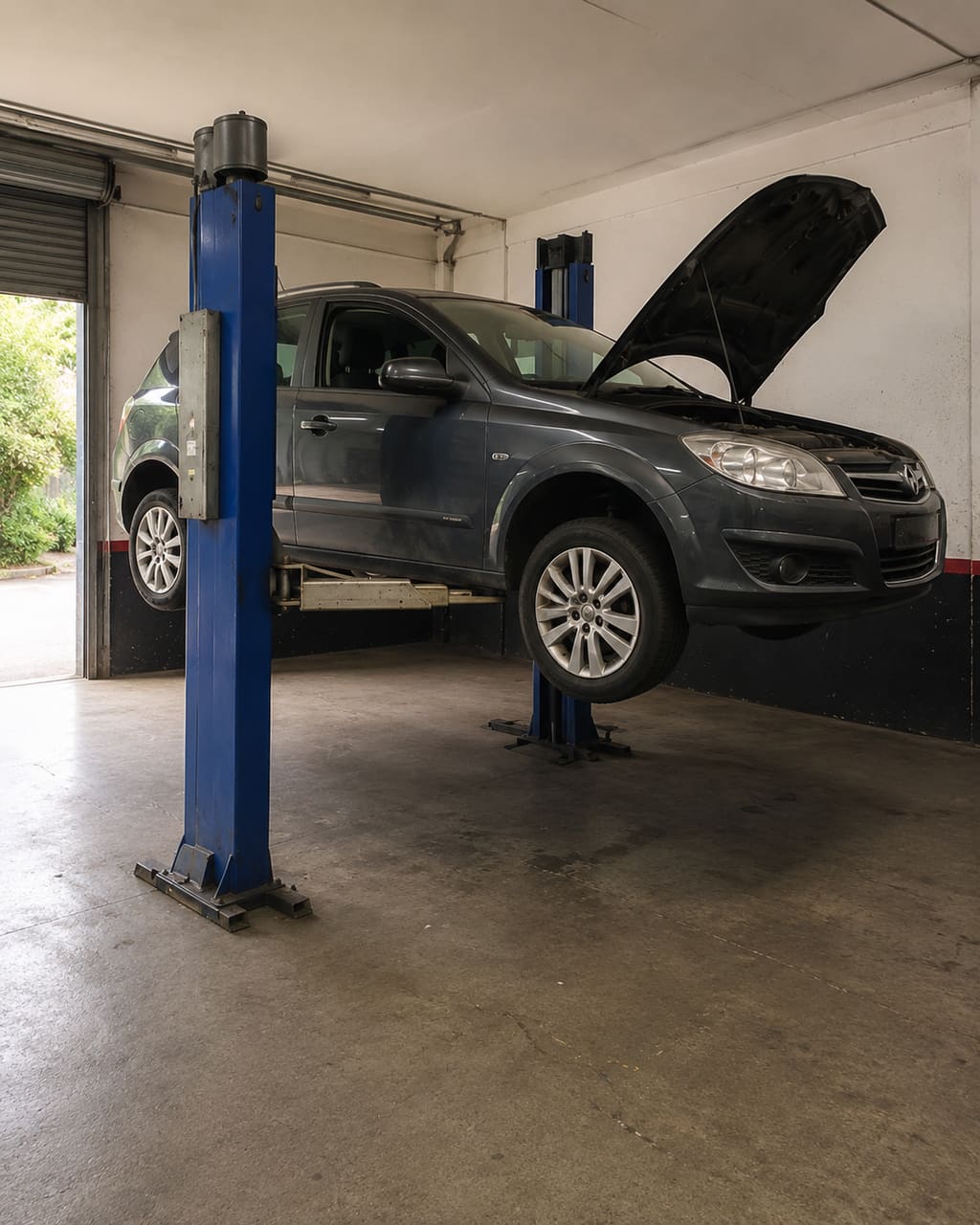
Illustrative examples, generated rather than photographed in a real business.
-
Roll it to the shutter
Strip lighting gives a green-grey cast that makes a clean workshop look like a lock-up, and no filter takes it out. Daylight from an open shutter or a roller door fixes it entirely. If the car cannot move, open everything you can and turn off whatever strip light is directly overhead.
-
Sweep the frame, not the workshop
Nobody expects a garage to be spotless, but a bin, an air line across the floor and a coffee cup on the wing are what people see instead of your work. Look at the edges of the frame before you press, not the middle. Twenty seconds.
-
The part in the hand beats the car on the ramp
A whole car tells a customer nothing. A worn pad next to a new one, held up, in focus, tells them everything and needs no caption. This is the single highest-value photograph in the trade and it takes five seconds while you have the old part in your glove anyway.
-
Get low for the car, close for the part
A car shot from standing height looks small and slightly sad. Crouch to about headlight height and shoot from three-quarters on. A part is the opposite, get close, fill the frame, and put it against a plain surface rather than against the floor.
-
Wipe your lens
This sounds trivial and it is the reason half of all workshop photographs look foggy. Your phone lives in a pocket in a garage. Wipe it on a clean cloth before every photograph and the improvement is immediate and permanent.
05 · The UK part
The British specifics
- March and September are your peaks because the UK changes number plates twice a year and the first MOT falls three years after registration, so those cohorts recur on the same anniversary for the life of the car. No American page can write that, because no American market has it.
- You do not have to use a main dealer to keep a manufacturer's warranty. Competition law, the Competition Act 1998 (Motor Vehicle Agreements Block Exemption) (No. 2) Order 2023, stops manufacturers tying warranty cover to their own franchised network, provided the car is serviced to the manufacturer's schedule with parts and fluids of the correct specification and you keep stamped records and itemised invoices. Repairs done free under the warranty itself still go through the dealer. This is the most valuable and least understood fact in the trade and it deserves a post of its own.
- DVSA runs a free MOT reminder by text or email, one month before the due date, and anyone can check a vehicle's full MOT history on GOV.UK. Both are free, both are official, and pointing customers at them is worth more trust than any offer. Note the reminder service does not cover Northern Ireland.
- First MOT is at three years in England, Scotland and Wales, and at four years in Northern Ireland, where testing is run by the DVA rather than DVSA. Say which applies to your customers.
- Clean air zones, ULEZ and the local congestion schemes are entirely British, entirely local and constantly misunderstood. If you are inside or near one, explaining what it means for a customer's car is content nobody nationally can write for you.
06 · Mistakes
What not to do
- Posting only finished cars in the car park. They all look the same and they say nothing about the work, the part, the fault and the explanation are the content.
- Competing on the price of an MOT. It is a capped fee and a race you cannot win; compete on what you do about what the MOT finds.
- Silence between peaks. Someone chooses a garage once and stays for a decade, and that choice is nearly always made in a quiet month by someone who already knew your name.
07 · And then, us
And then, the part we do
Everything above works with a phone and an open shutter. This is the pitch, and all three start from the one photograph you took by the shutter door. The car was not moved again. What changes is how far the assistant goes.
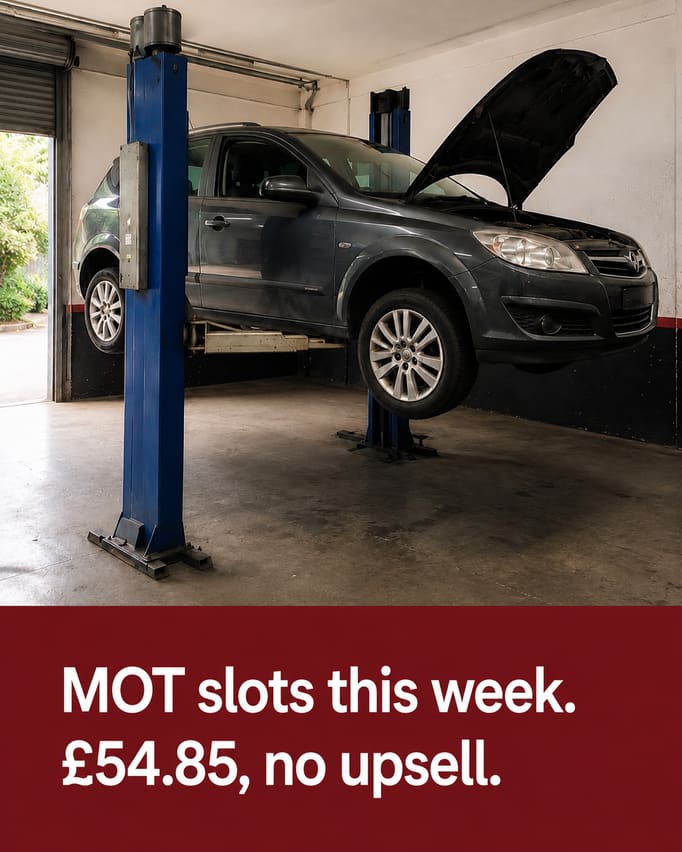
Layout Pro
The words and the panels go on top. The photograph underneath is exactly the one you took.
The booking post, out mid-August before the September rush.
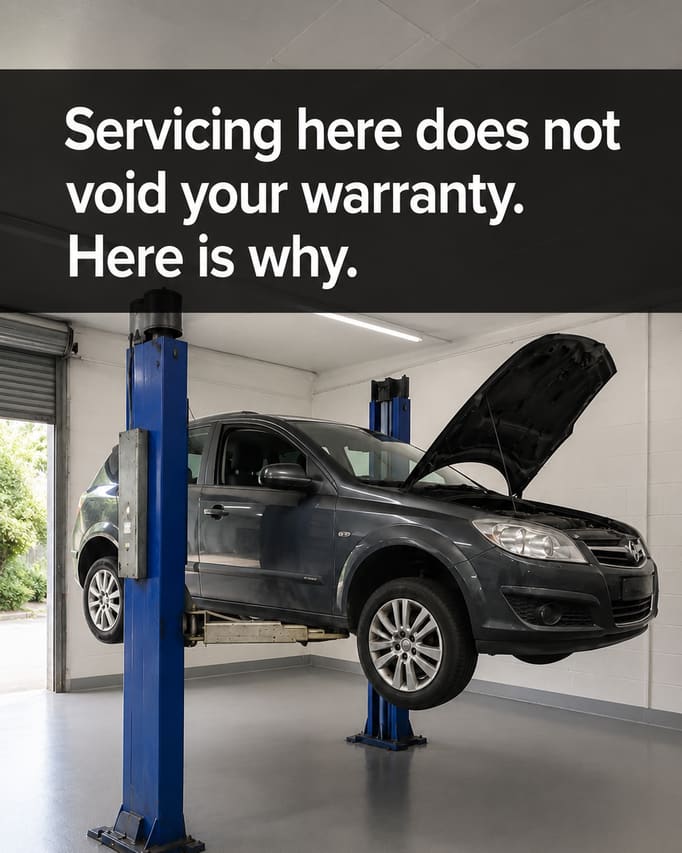
Visual Artist
Your subject is kept as it is, and the setting around it is replaced.
The myth-buster. The highest-value thing an independent can say.
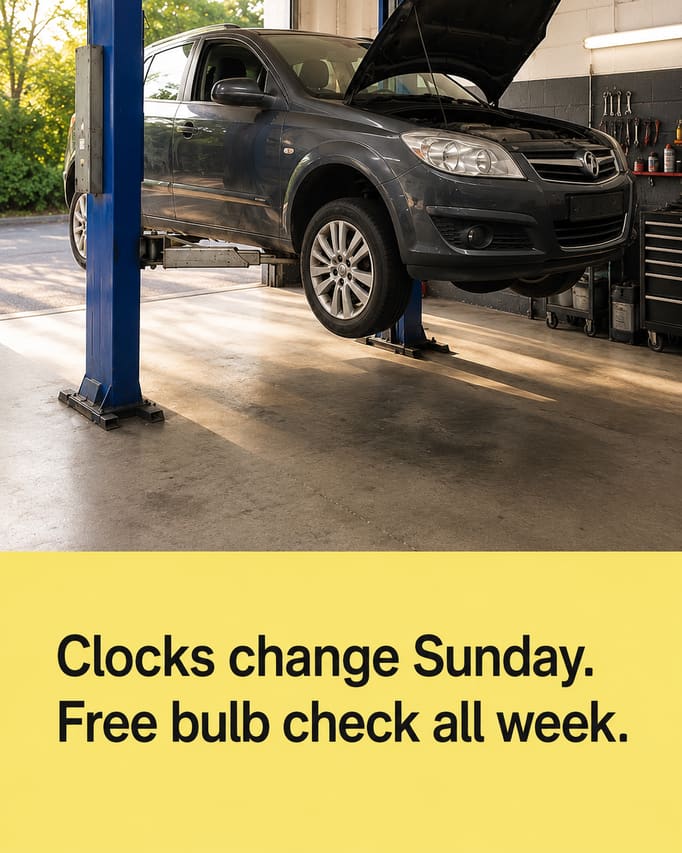
Image Maestro
Your subject is locked, then a new scene is built around it from a different angle.
The seasonal hook, scheduled in September for late October.
Illustrative examples, generated rather than photographed in a real business.
One post, whichever you pick.
Where it stops being three posts and starts being a campaign
March and September are not busy months, they are campaigns you either ran or did not. The useful version is the four weeks before each: the availability post, the what-an-MOT-actually-tests post, the advisory-versus-fail explainer, and the last-week booking reminder, dated, queued and going out while the ramps are full. That sequence is completely obvious in July and completely impossible in September, which is exactly the problem worth solving.
Sources
Where the numbers in this guide come from
Where a figure is somebody else's published work, it is linked so you can check it. Where a rule is stated, the link goes to the legislation or the regulator rather than to an article about it.
-
23,316 active MOT test stations in Great Britain
-
Around 43,069 vehicle maintenance and repair businesses
-
Servicing outside the franchised network does not void a warranty
Or let it write them for you.
SocialPostxr takes a photo and a line about your business and gives you three finished posts to pick from. The free plan needs no card.