For hairdressers & barbers
Social media for a salon or barbershop, written for the British high street
There are around fifty thousand hair and beauty businesses in the UK and most of them employ fewer than five people, which means most of them have nobody whose job this is. Here is the version that fits between clients.
01 · Plan the year
The dates that fill a column
Hair is bought on occasion far more than on schedule. Almost nobody books because six weeks have passed; they book because something is happening on Saturday. Your calendar is therefore a list of other people's occasions, and the post has to land while the decision is still open, which is earlier than instinct says.
-
The summer bank holiday, Monday 30 August 2027
The Friday and Saturday before it are the trade, not the Monday. Everyone is going somewhere.
Post The Tuesday before. People arrange a long weekend on a Wednesday.
-
Back to school, the first week of September
Two weeks of children's cuts that arrive all at once and then stop dead.
Post Mid-August, with your actual availability. Parents book the moment they think of it or not at all.
-
The clocks go back, Sunday 25 October 2026
Your last daylight in the window for five months, and the quiet reason your photographs get worse in November.
Post The week before, and use that week to take a stock of good daylight photographs you can draw on all winter.
-
Movember, all of November
For barbers this is the one national month that is genuinely about your trade. Beard trims, a charity board, before-and-after on the first and the thirtieth.
Post Late October, so people join at the start rather than hearing about it halfway through.
-
The Christmas run-up, the last three weeks of December
One of the busiest stretches of the year, and the one where a full column is decided in November rather than December.
Post From the second week of November. Say when you are shut over Christmas at the same time, it is the single most asked question of the month.
-
Mothering Sunday, 7 March 2027
The fourth Sunday of Lent, and nowhere near the American Mother's Day in May. Gift vouchers are the whole opportunity and vouchers need lead time.
Post Three weeks out, from mid-February. A voucher bought on the Saturday is a voucher you nearly missed.
-
Prom and leavers', May to early July
Updos, first cuts, whole friendship groups booking together. Dates vary by school, so a national list is no use to you.
Post Late April, and ask locally rather than guessing. In Scotland the term ends earlier and so does the season.
-
Wedding season, May to September
Trials are booked months before the day, which means the post that wins a wedding is nothing to do with the month the wedding is in.
Post January and February, when engagements from Christmas are being planned.
How to actually do the planning
- Get a wall calendar, not an app. Mark the eight dates above and the school holidays for your actual catchment, most councils publish them, and you have the skeleton of a year in twenty minutes.
- Work backwards from each date by three weeks and put the post there. The commonest mistake in the trade is posting about Mothering Sunday on Mothering Sunday, which reaches everyone who has already sorted it.
- Fill the gaps with work. Roughly one occasion post to three ordinary ones, the occasions bring the bookings, the ordinary posts are the reason anyone is still following you when the occasion arrives.
02 · What to post
Eight things you could photograph this week
-
The back of the head
The angle the client never sees and the one they most want to. Take it before you take the brush out; the shape is cleanest then.
-
A grow-out, honestly
The same cut at week one and week seven. It tells someone whether this cut will suit their life, which is the real question behind every consultation.
-
The colour correction nobody thinks is possible
With permission, and say how many hours it took. Box-dye rescues are a post people love to watch.
-
The chair that just came free
"Half four today." An underused post, and one that reliably fills the chair.
-
What you actually use
Name the products on the shelf and say why. It sells retail, and retail is the margin the column cannot give you.
-
How to make it last to week six
Wash days, dry shampoo, a trim rather than a cut. Useful enough to save, which is what the platforms reward.
-
A fade, in four frames
Guard one, the blend, the line-up, the finish. Barbering is a craft and the craft is invisible in a single finished photograph.
-
The apprentice's first solo
With their name. It is the cheapest loyalty you will ever buy and it tells people you are a place that trains.
03 · How often
How often, realistically
Three or four a week, and take the photograph while the client is still in the chair paying. The gap between finishing a head and remembering to photograph it is where most posts die.
You do not need to write on the day you shoot. Photograph everything, write on a Monday, schedule the week. Fifteen minutes of deciding beats two hours of trying to be creative on a Thursday night.
Do not commit to daily. Every salon that goes quiet in February committed to daily in January. Three a week for a year beats seven a week for five weeks by a distance nobody who has not tried it believes.
04 · Take a better photograph
How to photograph a finish so it looks as good as it is
The pair below is the same haircut. Nothing has been retouched between them and no equipment was bought, the only differences are where the client was standing, where the phone was, and what was behind her. That is almost always the whole gap between a photograph that undersells your work and one that does it justice.
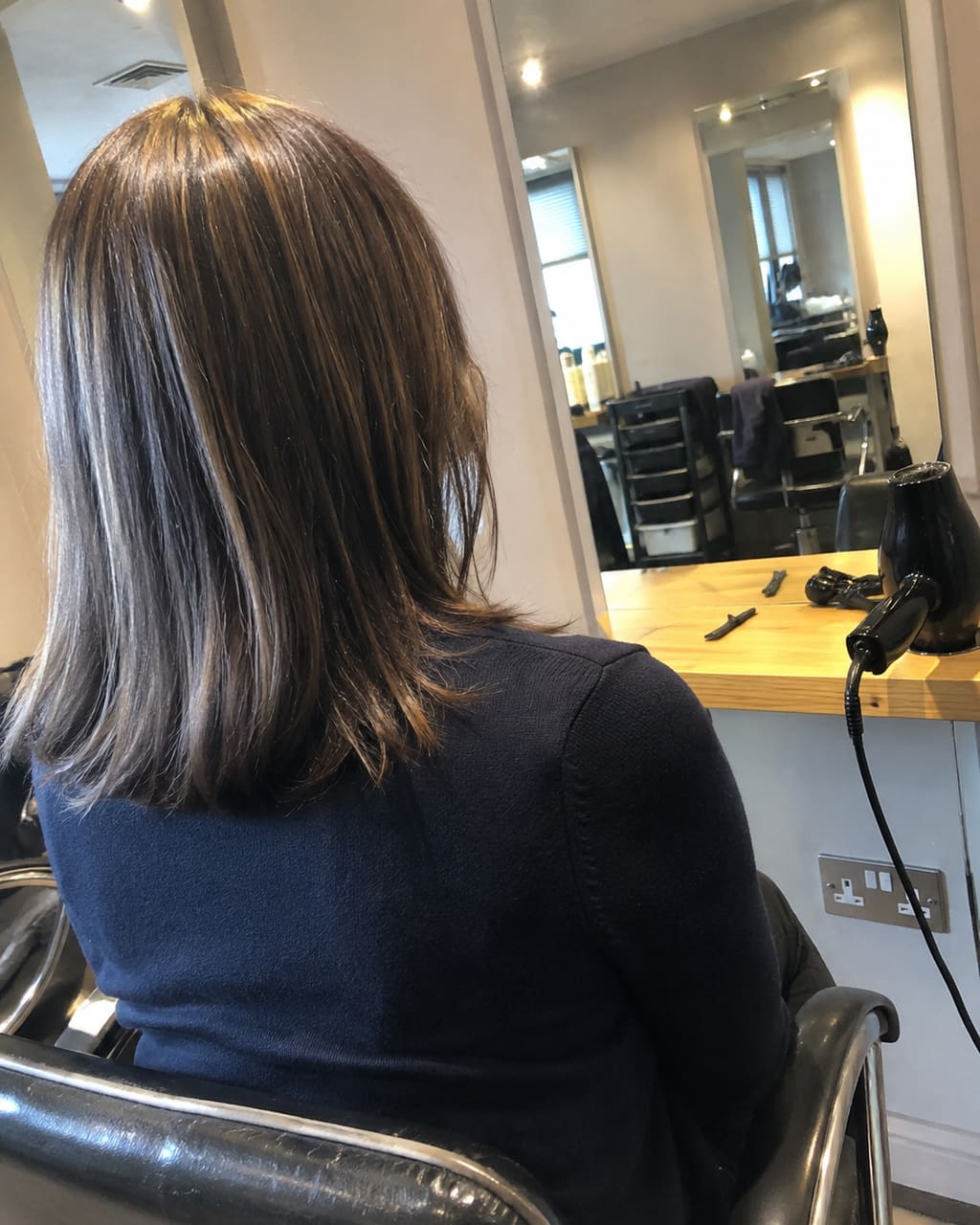
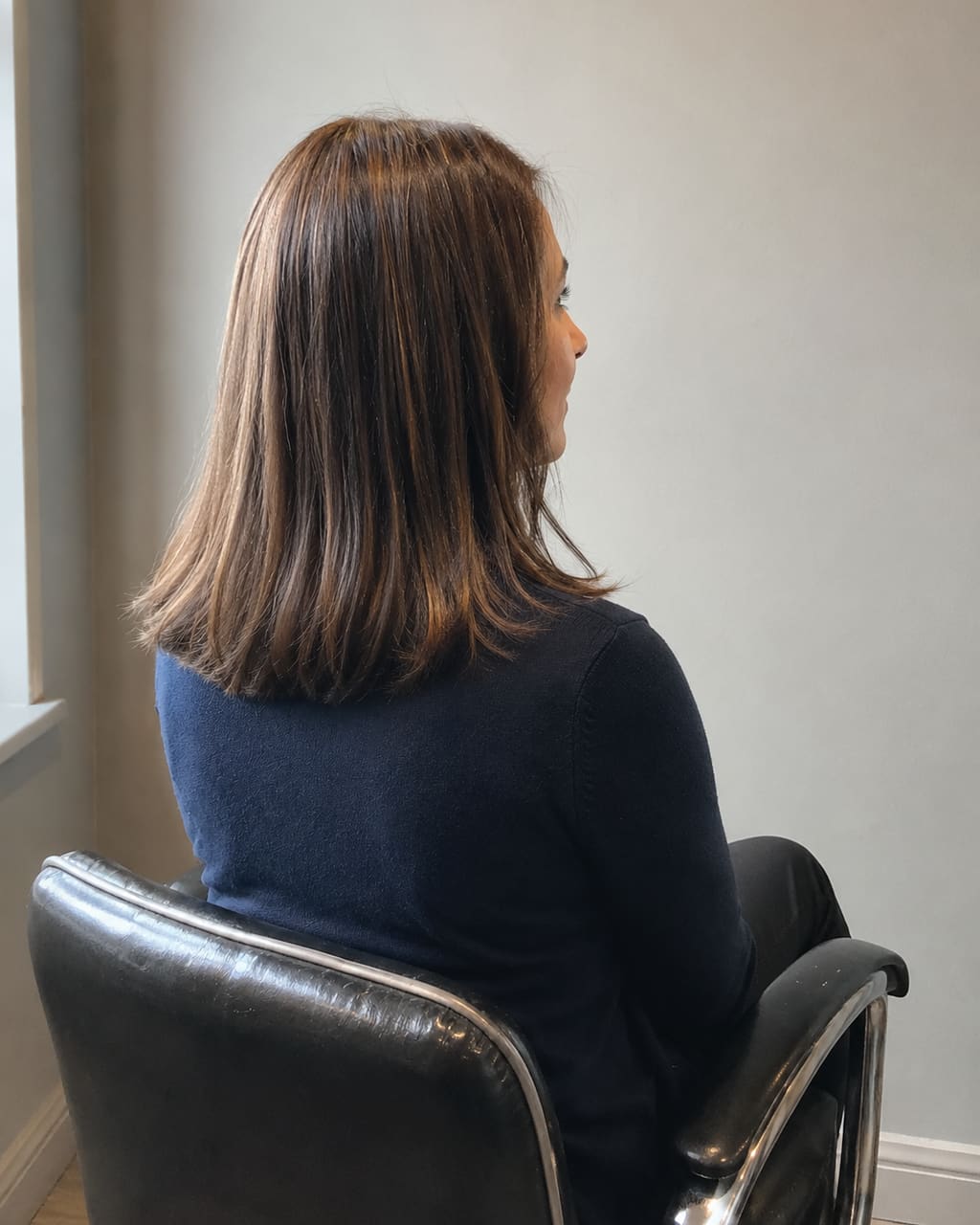
Illustrative examples, generated rather than photographed in a real business.
-
Turn the chair to the window
Salon spotlights sit above and slightly forward, which is the single worst place for a light to be: it digs shadows under the eyes and flattens the top of the head, exactly where the shape is. Move the client to within a metre of the window and turn her towards it. If the window is behind her, everything goes to silhouette.
-
Kill the mirror
A mirror puts you, your phone, the trolley and the person at the next station into your photograph, and one of them will be doing something. Shoot into a plain wall. If you have not got one, a plain wall is the cheapest piece of equipment in this list, a metre of matt paint in a corner will out-earn any ring light you buy.
-
Phone at eye level, not at hip
Held at waist height the lens looks up, the jaw goes heavy and the top of the head disappears. Raise the phone until it is level with the client's eyes and take a step back rather than leaning in, the wide lens on a phone is unkind up close, and a step back with a small crop after is always the more flattering photograph.
-
Tap the hair, not the face
Phones expose for whatever they think the subject is, and under salon lighting they will usually expose for a bright wall and let the hair go dark. Tap the screen on the hair itself, then drag down a fraction to pull the brightness back. Colour that looks flat in your photographs is nearly always overexposure, not the colour.
-
Three frames, then move on
Back, three-quarter, and one close on the section you are proudest of. Thirty seconds. The instinct to take twenty is what makes the whole thing feel like a chore, and the twentieth is never the one you use.
05 · The UK part
The British specifics
- There is no qualification or licence required to cut hair in England, anyone may legally do it, and registration with the Hair Council under the Hairdressers (Registration) Act 1964 is voluntary. That is exactly why saying what you are trained in is worth a post: the customer has no register to check, so you are the register.
- Premises are a different matter. Most London boroughs require the shop itself to register under section 21 of the Greater London Council (General Powers) Act 1967, and trading unregistered is a criminal offence; Northern Ireland requires registration with the district council under the Hairdressers Act (Northern Ireland) 1939. Scotland and Wales have no equivalent for hairdressing. Check your own council rather than a national article.
- The NHBF is the UK's largest trade body for hair and beauty businesses, and it is not the same organisation as the Hair Council. Mixing the two up in a post is a small tell that you have read an article rather than run a salon.
- Your catchment is walking distance, not a city. Name the street, the parade, the nearest station or the school. Local specificity is the one ranking signal a national competitor cannot copy.
- Sunday and Monday trading patterns are a British peculiarity worth stating. If you open Sunday, or you open Monday when the rest of the parade does not, say so every single month, it is the most common reason someone books elsewhere.
06 · Mistakes
What not to do
- Reposting somebody else's hair. It photographs beautifully, it books nobody, and clients can tell instantly, the lighting never matches the rest of your feed.
- Only posting the transformations. Most people want a trim they can live with, and if all they ever see is silver balayage they quietly assume you would find them boring.
- Going quiet in the busy weeks. December is when January's column is decided, and a salon that posts nothing between the 1st and the 24th starts the year cold.
07 · And then, us
And then, the part we do
Everything above you can do yourself, for free, with the phone in your apron. This is the pitch, and it starts from one photograph, the window-lit one you were just shown how to take. You did not go back and shoot it again for any of these three. What changed is how far you let the assistant go.
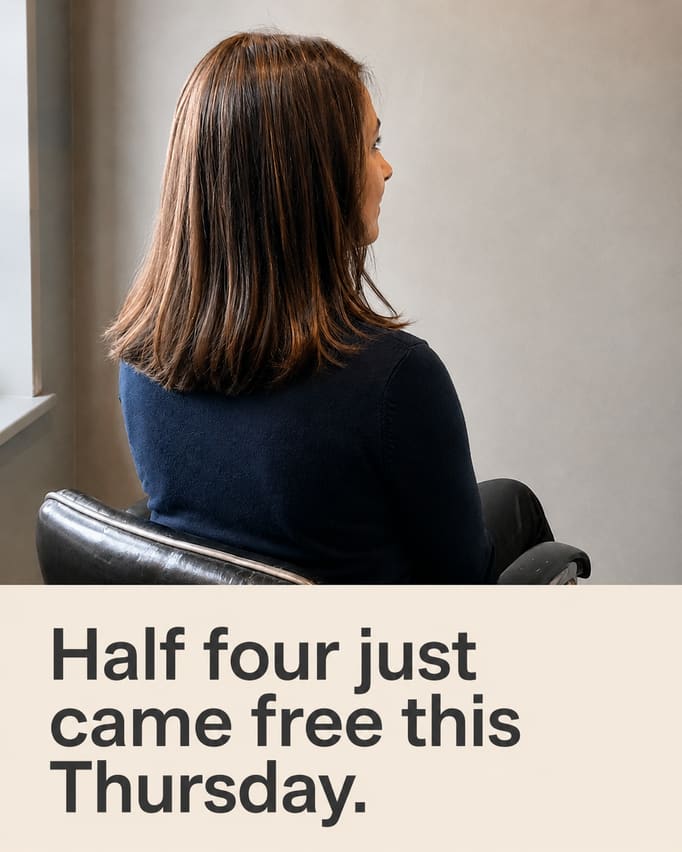
Layout Pro
The words and the panels go on top. The photograph underneath is exactly the one you took.
The gap-filler. Your photograph, a time and a day, out at nine in the morning.
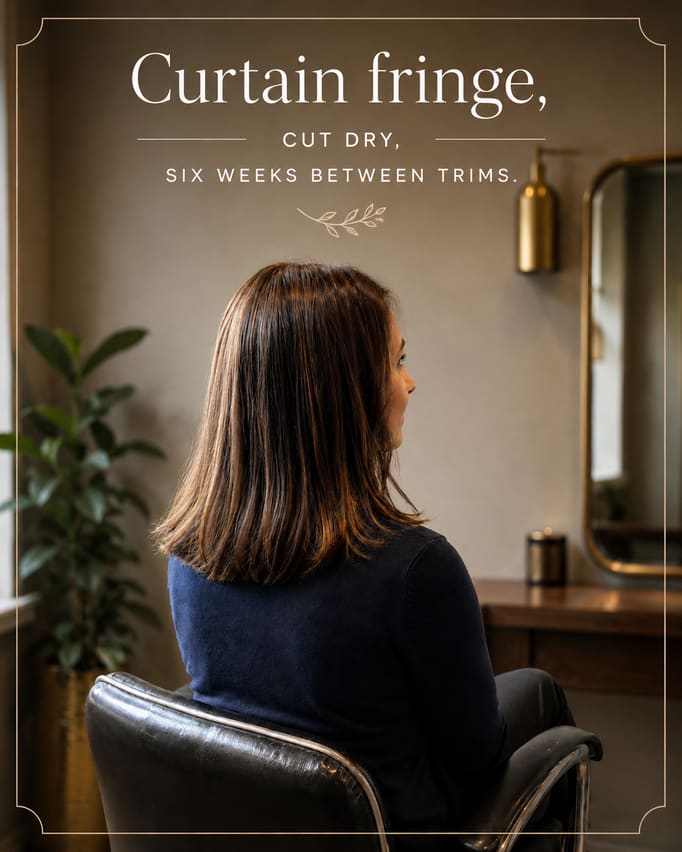
Visual Artist
Your subject is kept as it is, and the setting around it is replaced.
The craft post. The cut is untouched; only the room behind it changed.

Image Maestro
Your subject is locked, then a new scene is built around it from a different angle.
The occasion post, scheduled three weeks early and then forgotten about.
Illustrative examples, generated rather than photographed in a real business.
One post, whichever you pick.
Where it stops being three posts and starts being a campaign
One photograph making three posts is a convenience. A campaign is the thing that actually changes a month: you tell it Mothering Sunday is on 7 March and you want vouchers moving, and you get the run of posts back, the early one that plants the idea, the middle one with the price, the last-chance one on the Friday, dated, written and queued in the right order. That is the part nobody does by hand in a salon, because doing it by hand means sitting down on a Sunday night in February and thinking about March.
Sources
Where the numbers in this guide come from
Where a figure is somebody else's published work, it is linked so you can check it. Where a rule is stated, the link goes to the legislation or the regulator rather than to an article about it.
-
48,425 hair and beauty businesses in the UK
-
More than 80% employ fewer than five people
-
No licence is required to cut hair; Hair Council registration under the Hairdressers (Registration) Act 1964 is voluntary
-
London premises must register under section 21 of the Greater London Council (General Powers) Act 1967
-
Northern Ireland premises register with the district council under the Hairdressers Act (Northern Ireland) 1939
Or let it write them for you.
SocialPostxr takes a photo and a line about your business and gives you three finished posts to pick from. The free plan needs no card.